RTP Pokies in Australia: How Returns Work
 Available in AU

RTP compares stakes with prizes over extended play, but settings can vary by casino and do not predict individual spins.
Table of Contents
- How RTP Settings Shape a Pokie’s Long-Run Return
- What RTP Means in the Australian Online Pokies Market
- Checking Online Play, Payments and Withdrawal Conditions
- Why the Highest RTP Is Not a Guaranteed Result
- RTP and Payouts: What the Percentage Does—and Does Not—Show
- Reading RTP in the Australian Venue Context
- How to Interpret a Pokie RTP Figure
- Why an Online Pokie Can Show Different RTP Settings
- Why a Highest-RTP Ranking Cannot Be Verified Here
- What to Check Before Relying on an RTP Claim
How RTP Settings Shape a Pokie’s Long-Run Return
A pokie’s return to player, or RTP, is a theoretical measure of how much of the money wagered is returned as prizes across extended play. It is expressed as a percentage. The percentage describes the game’s designed return profile; it is not a setting that determines the result of a particular spin.
To understand what the figure represents, separate the total stake from the total prizes paid. RTP compares those two quantities across a very large number of plays. A higher theoretical return means that the game is designed to return a larger share of stakes as prizes over that scale, while a smaller share is retained by the game. The measure is useful for comparing return profiles, provided the figures refer to the versions of the games you are comparing.
That last condition matters because a game’s displayed name does not necessarily identify every detail of its configuration. A specialist review reports that some providers give casinos a choice of RTP settings for the same pokie. Where that option exists, a casino’s version can have a different theoretical return percentage from another casino’s version, even though the game title and basic presentation are the same.
If you’re looking for the best RTP pokies in Australia in 2026, use this list as a starting point and check the RTP information for the specific games you plan to play. The details below highlight only the available operator information, not a verified ranking of game returns.
1. Kingmaker
Payout speed: crypto ~90 minutes, fiat 1-5 days · Min. deposit: A$30 Kingmaker lists crypto withdrawals at around 90 minutes and fiat withdrawals at 1–5 days. The minimum deposit is A$30.
2. Neospin
License: Curacao Gaming Control Board OGL/2023/176/0095 (Hollycorn N.V.) Neospin lists a Curaçao Gaming Control Board licence, OGL/2023/176/0095, held by Hollycorn N.V.
3. LevelUp Casino
License: Curacao eGaming OGL/2023/174/0082 (Dama N.V.) · Min. deposit: A$15 LevelUp Casino lists a Curaçao eGaming licence, OGL/2023/174/0082, held by Dama N.V. Its minimum deposit is A$15.
4. Vegaz Casino
License: Curacao OGL/2024/1335/0780 · Min. deposit: EUR 20 Vegaz Casino lists a Curaçao licence, OGL/2024/1335/0780. The minimum deposit is EUR 20.
5. LuckyVibe
License: Curacao Gaming Control Board OGL/2023/176/0095 (Hollycorn N.V.) LuckyVibe lists a Curaçao Gaming Control Board licence, OGL/2023/176/0095, held by Hollycorn N.V.
6. WinSpirit Casino
License: Curacao eGaming OGL/2024/923/0383 (Antillephone N.V.) · Min. deposit: A$30 WinSpirit Casino lists a Curaçao eGaming licence, OGL/2024/923/0383, held by Antillephone N.V. Its minimum deposit is A$30.
7. Golden Pokies
License: Curacao Golden Pokies is listed with a Curaçao licence. No further operator details are available here.
8. House of Pokies
License: international iGaming licence – jurisdiction not named in the source · Payout speed: PayID 1-24 hours · Min. deposit: A$30 (PayID from A$10) House of Pokies lists an international iGaming licence, though the jurisdiction is not named in the source. PayID withdrawals are listed at 1–24 hours; the minimum deposit is A$30, or A$10 via PayID.
9. Thor Casino
License: Curacao – Antillephone N.V. (Versus Odds B.V.) · Min. deposit: EUR 20 Thor Casino lists a Curaçao licence associated with Antillephone N.V. and Versus Odds B.V. Its minimum deposit is EUR 20.
10. Lucky Dreams
License: Curacao · Min. deposit: A$20 (POLi) Lucky Dreams lists a Curaçao licence. Its minimum deposit is A$20 when using POLi.
The provider creates the available configurations; the casino’s selection determines which one is used for its game offering. This does not mean every pokie has several settings, or that every casino changes settings in the same way. It means that the title alone may not tell you which return figure applies. The configuration is part of the game version, just as much as the title is.
Think of RTP as a property of a configured game rather than a universal label attached permanently to its name. If a provider offers more than one setting, those settings represent different theoretical return profiles. A figure published for one configuration should not automatically be assigned to another. Even when the underlying game mechanics look familiar, the selected RTP setting can change the theoretical relationship between stakes and prizes.
This distinction can affect how you read comparisons of pokies with high RTP. A list that places one title above another is meaningful only if the figures being compared apply to the actual versions available to you. If one entry uses a different configuration from another, the title-level comparison may conceal that difference. The same issue applies when you encounter a return percentage in promotional copy, a review, or a game information panel: the relevant question is not only which game is named, but also which setting the figure describes.
Pokies in Perth: What to Check Before Visiting · Best pokies in Tasmania: checking venue details
The setting does not rewrite every visible part of a game. The title, symbols, sound and general play may remain recognisable across configurations. That surface similarity can make different RTP versions hard to distinguish unless the information provided identifies the applicable figure. The technical difference is in the return profile, not necessarily in what you see during an individual spin.
When a provider gives casinos a selection, the selected setting becomes relevant to the version offered at that casino. As a result, a figure attached to a game in one place may not describe the same game title elsewhere. You cannot resolve that uncertainty simply by recognising the title or its artwork. You need information tied to the actual configuration.
This is why a single percentage should be treated as a specific claim about a configured version, not as an inherent figure that follows a pokie everywhere. It is also why comparing the stated RTP across casinos requires care: different settings can account for a difference, even where the game name is unchanged. The figure is informative only when its scope is clear.
The practical consequence is straightforward. When you assess a game’s return profile, distinguish the game title from the RTP setting selected for that title. If a source gives a percentage without making clear which version it refers to, you cannot assume that it applies to every casino offering the game. If the setting is identified, the figure can describe that configuration’s theoretical return; it still should not be read as a promise attached to every play.
Attention: A game’s title alone does not guarantee a specific RTP, as providers may offer different configurations to different casinos.
A higher published RTP can therefore help identify a more generous theoretical return profile, but the label is not enough on its own. What matters is the relationship between the stated percentage and the configuration actually offered. Once you understand that distinction, apparent differences between versions become easier to interpret: the same named pokie can be associated with different RTP figures when a provider makes multiple settings available and casinos select among them.
What RTP Means in the Australian Online Pokies Market
An RTP figure can describe a feature of a pokie, but it does not establish that offering the game is lawful in Australia, that an operator is licensed here, or that a player can recover money if a dispute arises. Those are separate questions. For anyone assessing online pokies from Australia, the legal setting matters because there is no domestic online-casino licensing system that provides a local route for authorising real-money casino games.
Pokies in Canberra: How to Check Venue Access
The Interactive Gambling Act 2001 prohibits companies from providing real-money online pokies to people in Australia without a domestic licence. No domestic licences for that service have been issued, and there is no Australian-licensed online casino. The restriction is directed at operators: the law does not make an individual player criminally liable simply for playing. That distinction explains why an operator’s conduct and a player’s position should not be treated as the same legal issue.
Offshore websites may accept Australian customers, but that does not make their service Australian-authorised. The Australian Communications and Media Authority enforces the law and blocks access to illegal offshore gambling sites; internet service providers must comply with its blocklist. A site being visible or reachable at a particular time is therefore not evidence that it has permission to provide online pokies in Australia. Nor does the absence of a block establish that the operator is accountable under Australian licensing rules.
Pokies in Sydney: Finding Venues and Online Play
The practical consequence is important if a dispute occurs. If an offshore casino refuses to pay winnings, an Australian player has no legal recourse in Australia against that operator. A published RTP does not change this position. It is not a local licence, a guarantee that the operator will honour a withdrawal, or a way to enforce a claim through Australian authorities. Even where a game’s stated return can be identified, that information addresses the game’s configuration; it does not answer whether the business providing it is authorised or whether a player can obtain a remedy.
This is why “best RTP pokies Australia” can be misleading if read as a straightforward local shopping category. The phrase may suggest that a set of locally licensed online casinos can be compared on equal terms. There is no Australian-licensed online casino offering that framework. A figure attached to a pokie on an offshore site should instead be understood as a claim about that offering, not as evidence of Australian regulatory approval.
The distinction also applies to payment features and account tools. A familiar transfer option does not confer a licence or prove that a game’s return figure is independently verified. Likewise, an offshore operator’s terms do not become enforceable through Australian online-casino regulation merely because the website accepts Australian users. These details need separate assessment; they cannot substitute for a domestic licensing status that does not exist.
BetStop is a national self-exclusion service, but it applies to Australian-licensed operators only. It does not bind offshore casino websites. That limitation matters when considering whether a tool will restrict access: its coverage follows the operators within its scope, rather than automatically extending to every site a person can reach online.
Legal Recourse
If an offshore casino refuses to pay winnings, Australian players have no legal recourse in Australia against that operator.
The legal age for gambling in Australia, including online pokies, is eighteen. That age requirement does not alter the operator-side prohibition on providing real-money online casino games to people in Australia without a domestic licence. Nor does the fact that the law targets operators imply that offshore play is locally regulated or that an Australian player has a local authority able to compel payment.
For a reader looking at RTP pokies in Australia, the useful separation is between three questions: what return figure is being claimed for the game, whether the service is authorised to provide online pokies to people in Australia, and what recourse exists if the operator withholds funds. An answer to the first question cannot stand in for the other two. In this market, the absence of Australian online-casino licences and the lack of Australian legal recourse against an offshore casino are part of the context in which any RTP claim must be read.
Checking Online Play, Payments and Withdrawal Conditions
Payment access and withdrawal checks affect whether you can move money through a site; they do not establish that the site is lawful in Australia or that its published RTP information is transparent. PayID availability, in particular, is a payment detail—not evidence about a pokie’s settings, testing or return percentage. Real-money online casino services are prohibited for operators in Australia, so these checks should not be read as a recommendation to use an offshore casino.
Best Pokies in Geelong: Venue Hours and Checks
PayID depends on your bank
PayID is an alias linked to a bank account. To use it for a real-money gambling transfer, you first need to link the PayID to an account; it is not a separate balance that can be funded independently. Transfers can use an email address, mobile number or ABN as the alias. PayID operates through Australia’s New Payments Platform, which is supported by major banks and uses end-to-end encryption. Those features describe the payment system, not the status of a gambling operator.
A specialist review reports that some Australian banks, including members of the Big Four, have at times blocked PayID transfers to gambling merchants they identify. That is a bank-side decision and may affect a transfer even when the PayID details are correct. If a payment fails, check the message from your bank and contact it through its normal channels rather than assuming that a site’s payment page can override the block.
Treat any statement that PayID is accepted as a narrow claim about deposits. It does not show that withdrawals use the same route, that a payment will be processed, or that an operator has Australian authorisation. Nor does the presence of PayID confirm which RTP configuration applies to a game. These are separate questions, and payment branding cannot answer them.
Check withdrawal conditions before depositing
Read the withdrawal terms before sending money. Look for the available withdrawal methods, any processing steps, and the documents the operator may ask you to provide. Deposit and withdrawal methods can differ, so do not assume that a method shown for adding funds will also be available when you request a cash-out. Keep a copy of the terms you reviewed and any confirmation of your transactions.
Deposit and withdrawal methods can differ, so do not assume that a method used for adding funds will also be available for cash-outs.
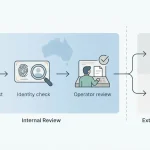
A specialist review reports that casinos may require identity checks before a first withdrawal. These can include proof of identity and proof of address, and an operator may also request a photograph of you holding your identification. Check the exact document requirements in the operator’s terms and prepare the required identity and address documents before requesting a first withdrawal. Submitting documents does not guarantee a payment; it is a verification step, and the operator’s rules determine how a request is handled.
Use care when sharing identity documents. Check the recipient and the stated submission process before uploading anything, and avoid sending sensitive material through an unverified channel. If a document is rejected, identify the stated reason and follow the operator’s formal process. A payment method or verification procedure cannot remove the risks associated with an offshore service, including the lack of Australian legal recourse if winnings are withheld.
Keep the checks distinct: PayID concerns how a transfer is initiated, verification concerns who is requesting a withdrawal, and RTP concerns a game’s theoretical return setting. One does not prove the others.
Why the Highest RTP Is Not a Guaranteed Result
A pokie’s RTP can help describe its expected return over extensive play, but it cannot tell you what will happen in a particular session. A high figure does not mean that a win is due, that losses will be small, or that a session will finish ahead. It is a long-run measure, not a forecast for the next few spins.
The reason is how each spin is produced. A Random Number Generator (RNG) determines the result of each spin, and that spin is independent of the ones before it. The machine does not remember a losing result and compensate you on the next turn. Nor does a recent win make another win more or less likely just because it has occurred.
Keno Online Casinos in Australia: Laws and Checks
This independence can make short sessions look very different from the return suggested by an RTP figure. A sequence may include wins, losses or a mixture of both; the theoretical return does not prescribe their order. Two people playing the same pokie under the same settings can therefore have different session results. Even one player can see very different outcomes across separate sessions.
Looking for the highest RTP pokies in Australia may seem like a way to reduce uncertainty. Comparing the applicable figures can help you understand a game’s stated long-run return, but it does not remove randomness from individual play. The higher figure does not guarantee a better result for you today, or establish what you will collect before you stop. It describes an expectation across many outcomes, not a minimum return for each person.
It is useful to separate two questions. “What return does this figure describe over extensive play?” concerns the game’s theoretical behaviour. “What will happen during my session?” concerns a short sequence of independent random results. The first question can be answered by an RTP figure when it applies to the version being played. The figure cannot answer the second.
That distinction matters when deciding how to play. Do not treat a run of losses as evidence that a win is now more likely, or a run of wins as proof that the same pattern will continue. Neither conclusion follows from the previous results, because each new spin is generated independently. A session’s history does not create a debt that the pokie must repay.
Do
- Set a spending limit in advance
- Treat the limit as a hard stop
- Understand RTP as a long-run average
Don’t
- Play to recover a loss
- Assume a win is due after losses
- View RTP as a session guarantee
If you choose to play, decide in advance how much time and money you are prepared to spend, and treat that amount as a limit rather than a target to recover. A theoretical return is not a reason to keep playing after reaching your limit. It also cannot turn a loss into a likely future gain.
The practical meaning of a high RTP is therefore limited but useful: it describes a long-run return expectation, not a promise attached to a session. You can use the figure to compare stated returns, but no ranking or percentage can predict the random sequence you will encounter. Short-term results may differ substantially from the theoretical expectation, and the next spin remains uncertain regardless of what came before.
RTP and Payouts: What the Percentage Does—and Does Not—Show
An RTP figure describes a theoretical return across play, not a payout owed to you. It cannot tell you that a particular spin will win, that a session will return a stated share of your stake, or that a displayed percentage will be reproduced in your own results. Treat it as a statistical description of the game, not as a personal payment promise.
That distinction matters when you read a claim about a pokie’s payout. “Return” can sound like money coming back to each player, but the percentage is not a schedule assigning part of your bets to you. It does not specify when a win will occur, how large it will be, or whether you will finish a session ahead. Your result is determined by the outcomes of the spins you actually play.
Live Casino Online in Australia: Games and Rules
Each spin is generated independently by a Random Number Generator (RNG). A previous result does not set the next one, and a run of losses does not create an entitlement to a win. In the same way, a win does not mean the next spin is more likely to lose. The RNG determines each outcome separately; the RTP figure does not override that process or predict its next result.
So, if a pokie is described as having a high return, read that as a statement about its theoretical behaviour over extensive play—not as evidence that it has the best payout for an individual session. Two players can use the same game and see very different results. One may collect a win early; another may spend the same session without a comparable return. Neither short experience, by itself, confirms or disproves the theoretical percentage.
A payout claim should therefore be read narrowly. Ask what the percentage is meant to describe, and do not translate it into “you will get this much back.” RTP alone does not reveal the timing or size of wins, nor does it guarantee that your stake will be returned. It is useful for understanding a game’s long-run return characteristic, but it cannot serve as a forecast of your balance after playing.
For an individual player, the practical result is simpler: the percentage is not a cash-out amount and does not promise a minimum return. It describes a theoretical measure, while your payout depends on the random outcomes of your own spins.
RTP vs Payout
An RTP figure is a statistical description of long-term game behaviour, not a personal payment promise for any individual session.
Reading RTP in the Australian Venue Context
Venue rules about responsible gambling address how a gambling venue responds to risk; they do not establish the return percentage of an individual pokie. A requirement for staff oversight or record-keeping is not a statement about a game’s settings. If you are assessing an Australian venue’s pokies RTP, keep those two questions separate: what the venue must do to manage gambling harm, and what return figure applies to a particular game.
A report by regionriverina.com.au describes a requirement taking effect from 1 July: venues with more than 20 gaming machines are to have a dedicated responsible gambling officer (RGO) present while those machines are operating. The report also describes a one-month grace period for venues to remove signage and put the officer arrangements in place. These details concern venue operations and the timing of compliance. They do not identify a pokie, publish its RTP, or show which return setting is in use.
The same report says venues will have to maintain a gambling incident register. Its purpose is to record occurrences, including behaviour that suggests a patron may be at risk of gambling harm or already affected by it. That record is about incidents and the venue’s response, not game mathematics. The existence of an RGO or a register therefore cannot be used as evidence that a particular pokie pays at a stated rate.
This distinction matters when you encounter a venue-level announcement alongside claims about game returns. A policy can apply across a venue without specifying the configuration of each machine. To assess an RTP claim, you need information that refers to the particular game and its applicable setting; responsible-gambling arrangements answer a different question.
Fast payout online casinos in Australia: what to check
The report’s grace period and officer requirement also do not imply that every venue has completed the relevant changes. They describe a transition and an operational obligation, not a test of game performance. Treating them as proof of a particular RTP would connect information that has no stated link.
In short, venue safeguards can tell you about oversight and the handling of gambling-related incidents. They cannot, by themselves, verify the return percentage attached to a pokie. Keep venue compliance information in its own category rather than using it to substantiate a game-level RTP figure.
How to Interpret a Pokie RTP Figure
A pokie RTP figure describes a theoretical return across repeated play, not the amount you should expect to receive from a particular spin. It is a way to characterise the game over a long span of outcomes. Reading it as a personal forecast gives the percentage more certainty than it can provide.
The distinction comes from how spins are produced. A Random Number Generator determines each spin, and each outcome is independent of the spins before it. A win does not make another win due, and a run of losses does not make a payout more likely on the next turn. The game does not adjust an individual result to bring your session into line with its published RTP.
This independence also explains why results over a brief session can look unlike the theoretical return. You might receive less than the figure suggests, more than it suggests, or no meaningful indication of it at all. A short sequence contains too little evidence to show how a game behaves over repeated play. The RTP is not a schedule that distributes returns evenly between players or sessions.
How RNG affects your results
A Random Number Generator ensures each spin is independent. This means the machine does not remember past results to compensate for losses or prevent subsequent wins.
When you see an RTP value, read it as a general property of the game version being described, rather than a promise attached to your account or your next spin. It does not tell you when a win will occur, how large it will be, or whether your balance will rise during a session. Those are outcomes of the individual spins, not predictions supplied by the percentage.
It is useful to separate the measure from the experience. The figure can help describe a game’s theoretical long-run behaviour, while your own results remain a finite run of independent random outcomes. Treating those as different things prevents a long-run statistic from being mistaken for a short-term expectation. A session can end well below or above the theoretical return without changing what the RTP figure means.
Why an Online Pokie Can Show Different RTP Settings
A pokie’s title and artwork do not necessarily identify its return setting. Some game providers give casinos a choice of RTP configurations for the same game. A specialist review reports that this can result in the same pokie having different return percentages at different casinos.
The distinction is between the game itself and the version configured for a particular casino. The underlying title may be recognisable across sites, but the selected setting can differ. So a percentage published for one casino should not automatically be assumed to apply to the same title elsewhere.
This matters when comparing high-RTP online pokies. A game name alone is not enough to establish which return figure applies. You need to know whether the stated percentage refers to the casino’s available version, rather than another configuration of the same game. If the setting is not identified, the figure may be accurate for one version but unhelpful for the version offered elsewhere.
Best Pokies in Adelaide: RTP and Venue Checks
Think of the RTP setting as a configuration attached to the game’s deployment, not as a permanent property that follows its name everywhere. A provider may make multiple settings available, while each casino’s version uses a selected setting. The fact that different settings exist does not establish which one a particular casino has chosen. Nor does it show that every game has multiple configurations.
When you see a return percentage beside a game title, check its scope. Does it describe the specific version available at that casino, or is it a general figure for the title? If the casino’s information does not connect the percentage to its own version, treat the match as unconfirmed rather than transferring a figure from another site.
This explains why two listings for what appears to be the same pokie can show different RTP figures without the title itself changing. The difference may come from the selected configuration. For comparison to be meaningful, the game identity and the setting both need to match. A headline percentage without that connection cannot tell you whether you are comparing equivalent versions.
Why a Highest-RTP Ranking Cannot Be Verified Here
A ranking of pokies by return depends on more than a game’s title. It must match each named game to the RTP setting that applies at the casino where it is offered. Without both parts, ordering games by a single percentage can misrepresent what a player would encounter.
Verify RTP Claims
- Identify the specific game version
- Check the RTP in the game’s rules or help section
- Compare the game settings with the casino’s description
- Confirm the active configuration with the operator if unclear
Some providers allow casinos to choose from multiple RTP settings for the same pokie. A specialist review describes this arrangement, under which one game may have different return percentages at different casinos. The title alone therefore cannot establish its applicable setting. Even when a figure is published for a game, it may not identify the configuration used at a particular casino.
A defensible comparison needs game names and settings that are verified together. If one entry uses a figure for one configuration and another uses a different configuration—or if the casino-specific setting is unclear—their positions do not form a reliable ranking. The issue is not how the games are ordered; it is whether the figures refer to the versions actually available at the casinos being compared.
This also affects the phrase “highest RTP”. It sounds like a fixed property of a game, but selectable settings can make the same title’s return percentage depend on the casino. A list that names games without identifying the relevant setting may suggest that the ranking applies everywhere, when it may not. Conversely, a figure attached to a title without a casino context cannot show which configuration a player would find there.
For a ranking to be meaningful, each entry would need to connect a verified game name, its applicable RTP setting, and the casino offering that version. Those details must be comparable across entries. Without that link, a numbered list would present precision without establishing that its figures describe equivalent versions.
The practical distinction is between a game’s identity and the configuration in which a casino makes it available. A title can remain the same while its selected RTP setting differs. That is why a claim about the pokies with the highest RTP cannot be checked by comparing names alone: the applicable setting is part of the claim, not an optional detail.
Best Pokies in Brisbane: Hours and Venue Checks
What to Check Before Relying on an RTP Claim
Before treating a published RTP figure as relevant, establish which version of the pokie it describes. A game’s title alone may not identify its return setting: a specialist review reports that some providers let casinos choose between multiple RTP configurations for the same game. The same pokie can therefore have different theoretical return percentages in different casino versions.
Check whether the figure is tied to the specific version offered, rather than presented as a general property of the game. Look for the RTP information in the game’s rules or help section, and compare it with the casino’s description. If those materials do not identify the applicable setting, ask the operator to confirm which RTP configuration is used. A figure without that connection cannot establish the return percentage of the version you are considering.
Keep the wording of any claim in view. A percentage described as applying to a game in general may not tell you which setting is active at a particular casino. Do not assume that a figure attached to a title elsewhere carries over unchanged. Provider, game title and displayed percentage are not enough on their own unless the information links the percentage to that specific version.
Best Pokies in South Australia: Venue and Play Checks
RTP information also cannot tell you what will happen in a session. Each pokie spin is a separate random event determined by a Random Number Generator. Checking the applicable setting can clarify which theoretical figure belongs to the version, but it cannot predict the result of your next spin or make a short run follow that figure.
Keep verification separate from other checks. PayID availability does not establish that a site is licensed, that its games are fair, or that its RTP claims are transparent. Before a first withdrawal, verify the operator’s identity-check requirements and have identity and address documents ready. BetStop applies to Australian-licensed operators and does not bind offshore sites.
A useful standard is simple: rely on an RTP claim only when the information identifies the game version and the setting that applies to it. If that link is unclear, treat the percentage as unconfirmed for that version—not as a dependable guide to an individual outcome.
Are online pokies legal for Australian players?
Yes, Australians can legally play on offshore sites that accept them, but those sites are not Australian-authorised. The Interactive Gambling Act prohibits operators from offering real-money online pokies to Australians without a domestic licence, and no such licences have been issued.
What’s the best strategy for playing pokies?
No strategy can predict or control a spin: each one is an independent random event determined by a Random Number Generator. You can set deposit, loss and session-time limits, or use self-exclusion tools to manage your play.
How do I know if an online casino is safe to play at?
There is no Australian-licensed online casino, and playing at an offshore casino does not give you legal recourse in Australia if it refuses to pay your winnings. ACMA blocks access to illegal offshore gambling sites, but that does not make an offshore operator Australian-authorised.
What is the legal age for online gambling in Australia?
You must be at least 18 years old to gamble online in Australia.
What does “wagering requirement” actually mean?
It is the turnover multiplier that tells you how much you must bet before bonus winnings can be withdrawn. For example, a 40x requirement on a $500 bonus means you must place $20,000 in bets.
Pokies

3-Reel Slots in Australia: How Spins Work
This guide explains independent spin results, game formats, RTP checks, free-play options and restrictions affecting...

Five-Reel Slots in Australia: How They Work
A practical guide to reel layouts, bonus features, RTP, paytables and the differences between free...

Seven-Reel Slots in Australia: How They Work
Seven reels describe the screen, not a predictable outcome; RNG results are independent, while RTP...

Australian Online Pokies: Laws, Payments and Offers
A practical guide to Australian real-money rules, payment checks, bonus terms and the limits of...

Aussie Online Casinos: Legality, Offers and Payments
Understand how offshore access differs from Australian licensing, and what bonus conditions, payment methods and...

Aussie Pokies Online in Australia: Free vs Real Play
A practical guide to free and real-money pokies, payment limits, bonus conditions and the difference...

Best Australian Pokies Online: Legal and Payment Guide
A practical overview of legal status, game outcomes, payment issues, bonus terms, withdrawal checks and...

Bonus Buy Slots in Australia: How They Work
A clear look at feature entry, random outcomes, demo limits and the details to check...

Adelaide Casino: Rooms, Poker and Venue Details
A practical overview of accommodation, poker, dining, events and venue facilities, with guidance on confirming...

Casino in Brisbane: Hotels, Poker and Venue Details
Coverage distinguishes casino-operated stays from nearby hotels and outlines details to verify for bookings, poker,...

Canberra Casino: Hotel and Stay Details
A room listing does not confirm a casino connection; verify the accommodation provider, address and...

Darwin Casino Guide: Gaming, Dining and Entertainment
Assess the venue, activities and practical arrangements separately, and confirm services that may change before...

Hobart Casino Guide: Poker, Rooms and Facilities
An overview of poker arrangements, accommodation, dining and facilities, with a reminder to confirm current...

Melbourne Casino Guide to Games and Visitor Details
Separate game types from venue offerings and distinguish on-site gambling from the availability of online...

Casino in Perth: Hotel Stays, Dining and Visitor Details
Find practical information on accommodation, dining, entertainment, facilities and checking venue details before a visit....

Best Casino in Queensland: Hotels, Dining and More
An overview of hotel stays, dining, parking, entertainment and other practical questions about Queensland casino...

Sydney Casino Guide: Hotels, Dining and Visitor Details
Understand how casino and hotel arrangements differ, and what to verify in room listings, booking...

Casino Hotels in Tasmania: Stays, Dining and Venue Details
A practical guide to comparing casino accommodation with gaming, dining, facilities and other venue information...

Casino in Victoria: Hotels, Gaming and Dining
An overview of accommodation, gaming, food and practical details to verify when considering a casino...

Casino Hotels and Facilities in Western Australia
Casino stays pair accommodation with gaming, but room features, booking terms and on-site amenities need...

Fast payout online casinos in Australia: what to check
Withdrawal speed depends on operator processing, payment checks and bonus terms, while a fast claim...

High-Volatility Slots in Australia: How They Work
A guide to how random outcomes, payout frequency, and bankroll discipline shape the experience of...

Instant Payout Online Casinos in Australia: How It Works
A withdrawal moves from casino checks and approval to payment handling, so the advertised casino...

Live Casino Online in Australia: Games and Rules
This guide separates the streamed table experience from software data, payment terms and legal questions...

Live Dealer Casino Online in Australia: Access
Australian law, licensing limits and practical checks shape what can be confirmed about live-dealer sites,...

Low-volatility slots in Australia: what to know
Volatility describes the broader pattern of win size and frequency, not the outcome of any...

Keno Online Casinos in Australia: Laws and Checks
A guide to Australian law, payment and withdrawal checks, game formats, bonus terms and the...

Best Pokie Machine to Play in Australia: A Guide
See how game features, odds, demo play and practical limits can affect a pokie session...

Best Pokies in Adelaide: RTP and Venue Checks
RNG outcomes are random, while RTP describes a game's return over time; venue information and...

Best Pokies in Brisbane: Hours and Venue Checks
A practical guide to checking venue and gaming-area hours, online pokies’ legal position, and key...

Pokies in Canberra: How to Check Venue Access
Venue listings may confirm general opening hours without showing whether the gaming area is operating;...

Best Pokies in Geelong: Venue Hours and Checks
Venue opening hours do not always confirm that the gaming area or pokies will be...

Pokies in Melbourne: How to Compare Venues
Venue addresses, operating rules, machine return settings and travel routes offer different checks when comparing...

Pokies in New South Wales: Limits and Access
A practical guide to loss limits and checking what is known about pokie access at...

Pokies in Perth: What to Check Before Visiting
A venue’s listed hours may cover dining or other services, not necessarily access to its...

Best Pokies in South Australia: Venue and Play Checks
A practical guide to game features, venue checks, access planning and the limits of what...

Pokies in Sydney: Finding Venues and Online Play
Location searches can mean a nearby venue or online play, so the details behind each...

Best pokies in Tasmania: checking venue details
Venue listings, published hours and machine information each have limits when assessing availability and pokie...

Progressive Jackpot Slots: How Pools and Payouts Work
Progressive pools grow from qualifying wagers, while eligibility, trigger rules and payout structures vary between...

Real-Money Online Pokies in Australia: Legal Guide
The guide separates operator restrictions from player liability and explains how payments, wagering terms and...

RTP Slots in Australia: Understanding Long-Run Returns
RTP is a long-run theoretical measure, so its percentage alone cannot predict session results or...

Video Slots in Australia: How Play and RTP Work
RNG outcomes, device controls, free-play limits and displayed RTP shape how online slots work across...

Big Red Pokies Online in Australia: Free Play
Free play shows the controls and sequence of actions, but each spin remains an independent...

Casino Dice Games in Australia: Rules and Formats
Casino dice games use physical or digital dice to settle wagers, with each format defining...

Crash casino games in Australia: rules and risks
Learn how rising multipliers, cash-out timing, Australian rules and payment conditions shape crash-game play. How...

Lightning Link Online Pokies in Australia: How It Works
Lightning Link is a series by Australian developer Aristocrat; individual versions and how they are...

Live Baccarat in Australia: Online Casino Access
A guide to Australian access, table formats, baccarat rules, odds and practical checks for comparing...

Live Blackjack Online Casinos in Australia: What to Know
Australia’s restrictions, live dealing, payment claims and gaps in blackjack-specific evidence shape a careful assessment....

Live Roulette in Australia: English-Speaking Dealers
This guide separates Australian rules for real-money online casinos from claims about dealers, wheels, odds,...

Mines Casino Game in Australia: Key Differences
Mines uses a minefield-style choice format, while pokies are electronic gaming machines with a different...

Most Trusted Online Casinos in Australia: Assessing Claims
A framework for weighing licensing, payments, bonus terms and game claims without treating operator statements...

Plinko Casino Australia: Games, Payments and Terms
A practical look at how game format, Australian access, payout conditions and bonus rules shape...

Pokies Tips and Tricks: What Players Should Know
Understand what random results, RTP and session limits mean—and why none of them can predict...

Real Money Casino Table Games in Australia
A practical guide to digital and live-dealer formats, game objectives, odds and the ways table-game...