iPAY9 Payments in Australia: Deposits, PayID and Withdrawals
 Available in US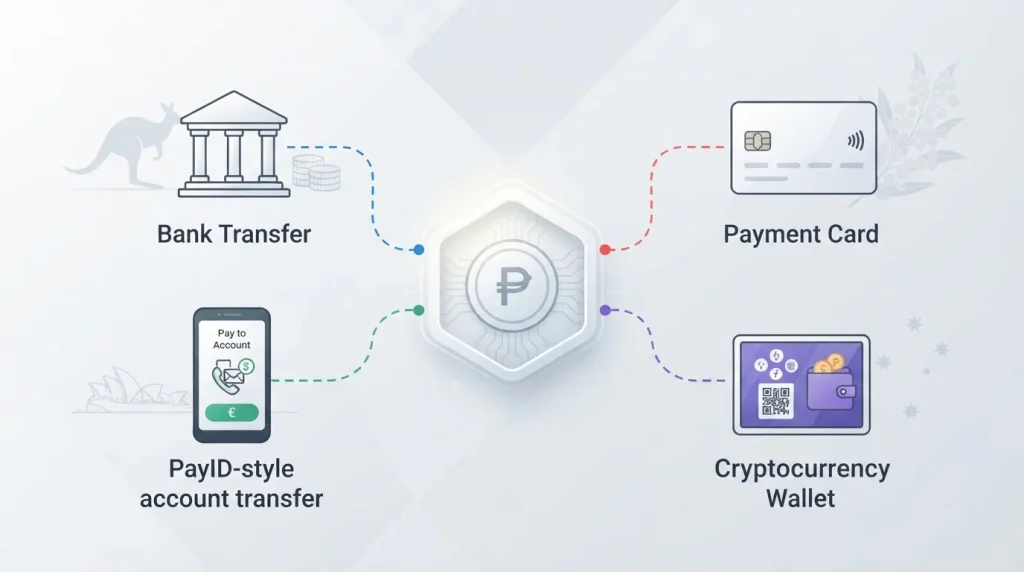
For Australian users, iPAY9 currently verifies two broad funding routes on its AU-facing site: bank transfer and crypto. PayID is highly relevant in Australian account-to-account payments, but it is not verified here as a current iPAY9 cashier option and should be confirmed inside the live cashier before you rely on it for a deposit. Exact fees, minimums, maximums and processing times are not assumed on this page because those details can vary by method, account state and current cashier terms.
The local context matters. The Reserve Bank of Australia’s 2025 Consumer Payments Survey found that cards represented about 73% of consumer payments, while PayID awareness reached about 80% and around half of respondents had used PayID in the prior year. Those figures explain why Australian users often expect familiar digital payment options, but they do not prove that every popular Australian method is available at iPAY9. Brand availability and Australian payment habits are separate questions.
Table of Contents
- What payment methods are verified at iPAY9?
- Why PayID matters to Australian users
- Australian payment habits versus casino cashier evidence
- Deposits: what to check before sending funds
- Withdrawals: treat cashout as a separate decision
- Where KYC fits into payments
- Bank transfer or crypto: which route fits better?
- Common mistakes to avoid
- Payment decision checklist for Australian users
- How to compare payment routes without guessing
- Bottom line
- iPAY9 Payments in Australia: Deposits, PayID and Withdrawals
What payment methods are verified at iPAY9?
The current iPAY9 Australia-facing site explicitly states that it supports bank transfer and crypto options. It also says deposits can be completed through a selection-and-confirmation flow and that withdrawals can be requested through linked bank accounts. Those statements establish the broad method categories, but they do not establish a universal fee, a fixed minimum deposit, an exact withdrawal limit or an instant processing time.
That difference is important. A payment method can be supported by the platform while the options visible to one user still depend on the live cashier. Before moving money, check the method list shown after login, the account currency, any displayed limits or charges, and the recipient or wallet details presented for that transaction.
| Payment route | Evidence level | What to verify live |
|---|---|---|
| Bank transfer | Verified on the AU-facing iPAY9 site | Deposit or withdrawal availability, account details, limits, fees and timing |
| Crypto | Verified on the AU-facing iPAY9 site | Supported asset, network, address, confirmations, limits and any conversion treatment |
| PayID | Major Australian payment method, not verified here as a current iPAY9 option | Whether PayID appears in your current cashier and the exact payee details |
| Cards | Important in Australian consumer behaviour, not established here as an iPAY9 method | Whether a card option is actually offered in your cashier |
Why PayID matters to Australian users
PayID is not just a casino-payment buzzword. It is an established Australian account-to-account payment service that lets a payer use an identifier such as a mobile number, email address or ABN rather than manually entering traditional account details. The RBA’s 2025 survey found strong growth in both awareness and use: around 80% of respondents knew about PayID and around 50% reported using it in the previous year.
That makes PayID a meaningful thing to look for in an Australian cashier. It does not make PayID automatically available at iPAY9 for every account. If the option appears, verify the displayed recipient identity and payment instructions before confirming the transfer. If it does not appear, do not substitute bank details from an old article or third-party image. The dedicated PayID page keeps the brand-specific question separate from the broader Australian payment context.
Australian payment habits versus casino cashier evidence
RBA data is useful for understanding what Australian users are familiar with, but it should not be used to manufacture a casino method list. Cards remained the dominant consumer payment method in 2025 at about 73% of payments. Online payments accounted for around 20% of consumer payments, and mobile or app transactions represented 46% of online payments. PayID adoption also increased strongly.
Those patterns explain why a user may prefer a mobile-friendly, account-to-account or card-style checkout. They do not show what iPAY9 accepts. The correct workflow is to use Australian payment data as context and the live iPAY9 cashier as the source of transaction-level availability. This distinction prevents a common review-site error: listing every popular local payment method as if popularity were evidence of merchant acceptance.
Deposits: what to check before sending funds
For a deposit, method existence is only the first check. Confirm the payment option in the live cashier, then check the currency and transaction details. If the account displays AUD, use the values shown there rather than a converted figure from a review. If a crypto route is selected, confirm the supported asset and network before sending because a correct-looking address on the wrong network can create a recovery problem.
With bank or account-to-account transfers, pay particular attention to the recipient details and any reference requested by the cashier. If the payment instructions identify an account name, compare it carefully before authorising the transfer. For a more focused walkthrough, use the deposit guide linked in the final checklist.
Withdrawals: treat cashout as a separate decision
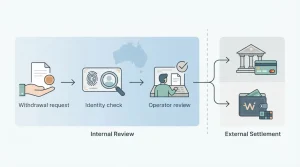
A good deposit method is not automatically a good withdrawal method. iPAY9’s AU-facing site states that withdrawals can be requested through linked bank accounts, but this overview does not assign a fixed processing time, fee or withdrawal limit. Those are higher-risk details that should come from the live cashier or current official terms at the time of the request.
Before depositing, it is worth opening the withdrawal section if the site allows it and checking what will be required later. Look for the available cashout routes, whether the destination must be in your own name, what verification status is required, and any displayed minimum, maximum or fee. This reduces the chance of learning about an important constraint only after funds are already in the account. The withdrawal guide linked below covers that side in more detail.
Where KYC fits into payments
Payment and identity checks are connected, especially at withdrawal. This page does not invent a fixed iPAY9 document list or processing time because those details require current primary-source verification. The practical point is simpler: if a cashier or account area indicates that verification is required, complete the requested process through the official account interface and make sure the personal details on the account match the payment destination.
For Australian bank transfers, consistent account details are particularly important as a basic error-prevention step. A mismatch can create additional review even when the payment method itself is supported. Do not use another person’s bank or wallet details simply to work around a mismatch.
Bank transfer or crypto: which route fits better?
Bank transfer is the more familiar choice for users who want funds to move between a casino account and a conventional bank account. Its main decision points are recipient details, account-name matching, displayed limits and the withdrawal route. Crypto can suit users who already understand wallets and networks, but it adds operational checks that do not exist with a standard bank transfer.
- Bank transfer suits you better when
- You want a conventional account-to-account route, prefer AUD-facing banking workflows, and are comfortable waiting for the timing displayed by the cashier rather than expecting an instant transaction.
- Crypto suits you better when
- You already control a compatible wallet, understand network selection and address verification, and can evaluate any conversion or volatility outside the casino transaction itself.
Neither route is automatically cheaper or faster. Those are method-specific claims and need current cashier evidence. Choose based on the live terms you can actually see, not on generic assumptions about bank transfers or cryptocurrency.
Common mistakes to avoid
- Assuming PayID because it is popular in Australia. Its broad adoption is verified, but iPAY9 availability still needs a live-cashier check.
- Assuming cards because they dominate consumer payments. RBA usage data describes Australian behaviour, not the iPAY9 cashier.
- Converting an old minimum into AUD. Use the current displayed cashier value instead of a review-site conversion.
- Sending crypto on the wrong network. Verify both the asset and network shown for the transaction.
- Focusing only on deposits. Check the withdrawal route and verification requirements before funding.
- Expecting zero fees or instant cashout. This page does not make either claim without current official transaction evidence.
Payment decision checklist for Australian users
- Open the current iPAY9 cashier and identify the methods actually offered to your account.
- Confirm the account currency and use the displayed figures rather than third-party conversions.
- For PayID, use it only if it appears in the live cashier and verify the payee details before authorising payment.
- For bank transfer, confirm recipient details, reference requirements and account-name expectations.
- For crypto, confirm asset, network and wallet address character by character.
- Read any displayed minimum, maximum, fee and processing information before confirming.
- Check the withdrawal route and verification requirements before making a first deposit.
- Review the broader trust and licence, including the separate Australian licence status, rather than treating convenient payments as proof of regulatory standing.
How to compare payment routes without guessing
Use the cashier as a transaction screen, not as a promise that every method will remain available indefinitely. A useful comparison starts with what is visible for your account today, then checks whether the same route works for both funding and cashout. A method that is easy to deposit with can be less convenient if withdrawals use a different channel or require extra account matching.
Also separate transaction convenience from operator trust. Fast-looking payment technology does not establish licensing status, dispute options or the quality of account verification. Those questions belong in the dedicated trust pages. Likewise, a familiar Australian method does not remove the need to verify who the payee is, what reference is required and whether the payment is being made from an account in your own name.
Bottom line
iPAY9 currently verifies bank transfer and crypto support for its Australia-facing service. PayID is highly relevant in the Australian market, but it is not treated here as a verified iPAY9 option and should be confirmed at cashier level rather than assumed. RBA data shows why PayID, cards and mobile payments are familiar to Australian consumers, yet those market-wide habits must remain separate from the methods a specific casino actually offers.
The safest practical sequence is to check the live method list, currency, recipient details, limits, fees and withdrawal route before sending money. Use the child guides for deposit guide, withdrawals and PayID guide when you need a narrower decision.
For related context, see the main review.