iPAY9 PayID in Australia: What to Verify Before Paying
 Available in US
PayID is a mainstream Australian account-to-account payment method, and an AU-focused independent review reports PayID-style deposits at iPAY9. That is useful evidence, but it is not the same as a live cashier confirmation. Before sending money, open your current iPAY9 cashier and check that PayID is actually displayed for your account, then verify the payee identifier, recipient name, amount, currency and any instructions shown for that transaction.
The distinction matters because PayID itself is well established in Australia while a casino’s available payment routes can change. The Reserve Bank of Australia’s 2025 Consumer Payments Survey found awareness of PayID at around 80 percent and use in the prior year at around 50 percent. That explains why Australian players search for PayID, but it does not prove that a particular iPAY9 account has the option at this moment.
Table of Contents
- What is actually verified about iPAY9 PayID?
- Why PayID is familiar to Australian users
- Live-cashier checklist before sending funds
- What this page deliberately does not publish
- Why the recipient-name check matters
- If PayID is not visible
- A PayID-style payment should pass three checks before you send it
- What a name mismatch should change
- Keep a simple record until the balance is settled
- Bottom line for Australian users
- iPAY9 Payments in Australia: Deposits, PayID and Withdrawals
What is actually verified about iPAY9 PayID?
The evidence has two separate layers. First, PayID is a widely adopted Australian payment service. Second, an independent Australia-focused review specifically associates iPAY9 with PayID-style deposits. The second point is a brand signal, not a guarantee of current cashier availability.
| Question | Evidence | Practical conclusion |
|---|---|---|
| Is PayID widely used in Australia? | Yes. RBA survey data shows strong awareness and recent use. | It is a normal Australian payment-intent signal. |
| Is iPAY9 linked with PayID? | An AU-focused independent source reports PayID-style deposit support. | Treat this as a reason to check the cashier, not as a permanent promise. |
| Are current iPAY9 PayID credentials verified here? | No. | Never copy a payee identifier from this article or an old saved image. |
For the broader set of verified payment categories, see the payment overview.
Why PayID is familiar to Australian users
PayID lets a payer address a bank transfer using an identifier such as a mobile number, email address or ABN instead of manually entering BSB and account numbers. The RBA also notes that the recipient name can be shown before payment, which can help reduce misdirected transfers.
Its popularity has grown quickly. In the 2025 Consumer Payments Survey, around half of respondents said they had used PayID in the previous year, up from 32 percent in 2022. Around 80 percent were aware of it. PayID use also increased across age groups, so it is no longer a niche feature associated only with early adopters.
That local familiarity is why a PayID option can feel more straightforward than a less familiar funding route. It should still be treated as a payment instruction that needs to be checked carefully each time.
Live-cashier checklist before sending funds
- Open the current cashier from your logged-in iPAY9 session.
- Confirm that PayID is listed as an available deposit method for your account.
- Check the currency displayed for the transaction and make sure the amount is the one you intend to send.
- Use only the PayID or recipient details shown for that transaction. Do not reuse details from a forum, old article, chat image or previous deposit.
- Confirm the recipient name presented by your bank before authorising the transfer.
- Read any current minimum, maximum, fee or reference instruction shown in the cashier.
- Keep the banking confirmation and transaction reference until the casino balance is credited.
The same logic applies to other bank-transfer deposits. If you are comparing several funding routes, the deposit guide explains what to check for bank transfer and crypto without assuming a fixed cashier configuration.
What this page deliberately does not publish
This guide does not publish a current PayID email address, phone number, ABN, bank account, QR code or other mutable credential for iPAY9. Payment endpoints can be transaction-specific or can change over time. Republishing them would create a risk that a reader sends funds using stale instructions.
It also does not promise zero fees or instant credit. The fact that PayID is designed for fast account-to-account transfers does not establish the casino’s own posting time, internal checks or fee policy. Any live fee, limit or timing shown in the cashier should take priority over static editorial text.
Why the recipient-name check matters
One of PayID’s practical advantages is that the banking flow can show a recipient name before the payment is authorised. Use that moment as a verification step rather than clicking through automatically. The name displayed by your bank should make sense in the context of the instructions shown in the current cashier. If it does not, stop and recheck the transaction instead of guessing why the names differ.
This is also why copying an identifier from somewhere else is poor practice. A PayID can be syntactically valid while still pointing to a recipient that is not the one intended for your current transaction. The live cashier and your bank’s confirmation screen give you two opportunities to compare what you are about to send. Use both.
If the cashier asks for a payment reference, copy that reference exactly as displayed. A correct recipient with a missing or altered reference can still create reconciliation problems after the money leaves your bank. Keep the receipt until the casino balance reflects the payment.
If PayID is not visible
If you open the cashier and PayID is not offered, do not assume that an old review is more authoritative than the current account screen. Use a payment method that is actually displayed and that you understand. iPAY9’s Australia-facing material verifies bank transfer and crypto as broader payment categories, but the exact options available to an individual account still belong to the live cashier.
Do not try to recreate PayID instructions manually from old recipient details. If you specifically want to know whether PayID is temporarily unavailable or account-specific, use the platform’s official support channel and ask about the current cashier options.
A PayID-style payment should pass three checks before you send it
PayID is familiar to many Australians, which can make the payment step feel routine. That familiarity should not replace verification. The first check is availability: confirm that the option is actually shown inside the current iPAY9 cashier for your account. The second is destination: read the payee information presented by the live payment flow and make sure the name or identifier shown by your banking app is consistent with what you were instructed to use. The third is transaction context: confirm the amount, currency and any reference that needs to accompany the transfer.
If any of those three checks fails, do not try to repair the payment by guessing an identifier from an older guide or by sending a small test amount to details found elsewhere. A static review cannot safely publish a mutable payment destination. The useful information here is the checking sequence, not a reusable payee credential.
What a name mismatch should change
A mismatch between the expected recipient and the name displayed by your bank is a reason to stop before authorising the payment. It does not tell you what the correct replacement should be. Return to the live cashier, confirm that you copied the current instruction correctly, and use the platform’s current support route if the difference remains unexplained.
The same logic applies to a missing or unfamiliar reference field. Some account-to-account payment flows rely on transaction-specific information to connect the incoming payment with the right account. This page does not claim that iPAY9 always uses a particular reference format. It recommends checking the instruction that accompanies the current transaction and preserving that information with your payment receipt.
Keep a simple record until the balance is settled
After authorising a payment, retain the bank confirmation, the amount, the time and the non-sensitive reference shown for the transaction until the account balance is updated or support has resolved the issue. Avoid publishing those details in public forums. If you need help, provide only the information the current support channel requests and keep passwords, authentication codes and full banking credentials private.
This approach is more useful than promising an instant credit time. A payment can be easy to initiate and still require investigation if the wrong recipient, reference or amount was used. The best protection is to verify the live instruction first and keep enough information to trace what you actually sent.
Bottom line for Australian users
PayID is highly relevant in Australia, and there is independent evidence linking it with iPAY9 deposits. The safe editorial conclusion is narrower than a blanket availability claim: check the live cashier immediately before paying and use only the current recipient information shown there.
For a wider decision about the site, return to the main review. For deposit method comparisons, use the payment overview and deposit guide rather than treating PayID as a permanent account feature.
Before closing the banking screen, confirm that the amount you approved matches the amount you intended to send and retain the receipt until the account balance is reconciled.
iPAY9 Payments in Australia: Deposits, PayID and Withdrawals

How to Deposit at iPAY9 in Australia
iPAY9's current Australia-facing site confirms bank transfer and crypto as supported payment categories. Before depositing,...
iPAY9 Withdrawals in Australia: Methods, KYC and Checks
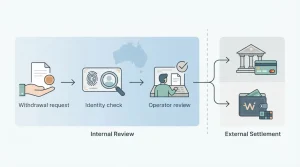
iPAY9's current Australia-facing site states that withdrawals can be requested through linked bank accounts and...