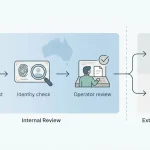
iPAY9 KYC and Identity Verification
 Available in US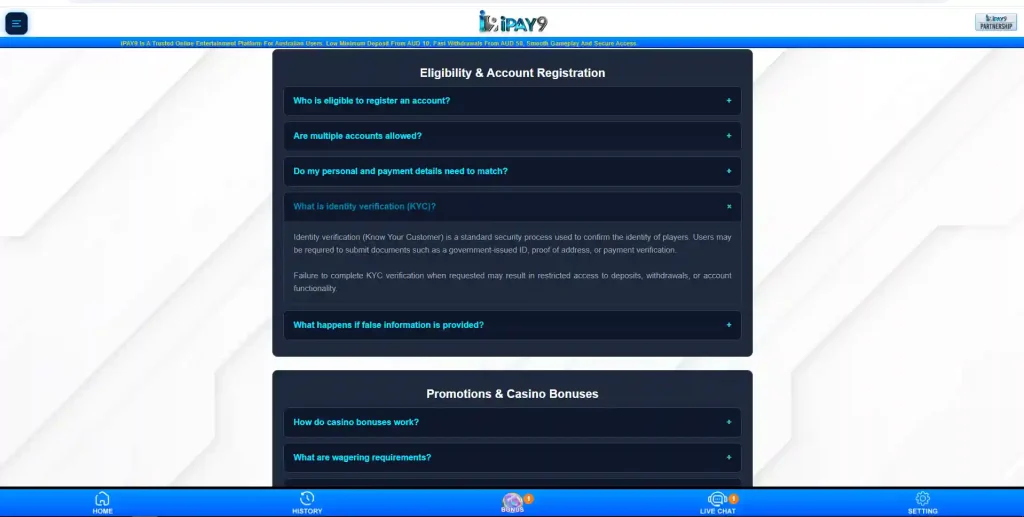
Identity verification is part of the iPAY9 account flow, but current public iPAY9 information does not confirm an exact document checklist or a fixed processing time. Those are high-risk details, so they are deliberately omitted rather than reconstructed from common casino practice or third-party assumptions.
The practical takeaway is still useful: registration and KYC are separate checkpoints, verification can affect account access or withdrawals, and the instruction shown in your current authenticated account should take priority over any static review. If iPAY9 asks you to verify your identity, follow the specific request displayed there and use the platform’s current support route if the requirement is unclear.
Table of Contents
- What we could verify
- Why KYC can matter to account access
- How KYC connects to withdrawals
- What to check in your account
- What not to send casually
- Why this guide does not publish a standard document list
- How to handle a verification delay
- KYC, trust and regulatory claims are different questions
- Questions to ask support
- Prepare for verification without guessing the document list
- Bottom line
- iPAY9 Account Guide: Registration, Verification and Support
What we could verify
This boundary matters because document lists and verification timelines can change. A review that states “passport, licence and utility bill” as if those items are permanently required would be making a brand-specific claim without current primary evidence. This page does not do that.
Why KYC can matter to account access
KYC is an identity checkpoint, not another name for registration. The broader account overview shows where verification sits in the full account lifecycle. Registration creates the account using the live sign-up flow. Verification is the later process of confirming information when the platform requires it. The dedicated registration covers the first step without inventing the current form fields.
The important operational point is consistency. Information entered when the account is created can become relevant if the platform later asks you to confirm identity or account ownership. If the details do not line up, the platform may need clarification before the account process can move forward.
That does not justify claiming that a particular mismatch always causes a suspension or that every account is verified at a fixed moment. Identity verification is part of the account flow, but there is no basis here for a universal trigger schedule.
How KYC connects to withdrawals
Identity checks matter most to many users when money is being moved out of the account. A withdrawal can intersect with account verification because the operator may need to establish that the person requesting the cashout is the account holder and that the payment instruction belongs to the same account context.
The separate withdrawals covers cashout workflow and deliberately avoids exact processing times, limits and fees that were not confirmed by current official evidence. On this KYC page, the useful rule is narrower: if a withdrawal is waiting on verification, resolve the account request shown in the live interface rather than assuming the payment is simply “slow”.
Do not respond to uncertainty by repeatedly changing profile details, opening another account or sending sensitive identity material to an unverified contact. Keep the process inside the current account or verified support route.
What to check in your account
This checklist intentionally avoids naming document types. The live request is the only reliable place to learn the exact current requirement when no official public KYC checklist can be retrieved.
What not to send casually
Identity material is sensitive. A KYC process may involve personal information, so treat the submission channel itself as part of the verification task. Do not post identity images publicly, send them to addresses copied from unrelated directories or paste full document details into a public forum while asking for help.
If support directs you to a verification step, make sure the route is part of the current platform or another clearly identified official channel. This page cannot validate a private upload endpoint from outside your authenticated account, so it does not name one.
The same caution applies to payment information. Verification may be connected to account ownership, but there is no reason to disclose passwords, full card credentials or other unnecessary secrets in an ordinary support conversation.
Why this guide does not publish a standard document list
Many casino KYC explainers use an industry-standard list to make an article look complete. That is exactly where false precision creeps in. A passport may be common in identity checks, and proof of address may be common elsewhere, but common practice is not enough to state that iPAY9 currently requires a particular item.
Exact KYC documents and processing times should come from a current official account, KYC or terms notice. Because those details are not established here, this page omits the specifics rather than presenting a generic checklist as an iPAY9 requirement.
That distinction also keeps the rest of the page direct. The fact that the document list is unavailable does not make every account fact uncertain. The existence of identity verification remains an allowed qualitative claim.
How to handle a verification delay
Without a verified processing-time promise, there is no responsible basis for saying that iPAY9 KYC should finish within a certain number of minutes, hours or days. If your account shows a pending verification state, check whether the interface identifies an outstanding action. If it does, address that specific request. If it does not, use support and ask what stage the review has reached.
When describing the issue, provide the account reference or non-sensitive transaction information the platform asks for, the approximate time you submitted the verification request and the exact status shown in your account. Avoid repeatedly uploading different files unless support or the interface tells you the previous submission was insufficient.
A useful goal is not to “speed up KYC” through guesswork. It is to remove ambiguity: what was requested, what was submitted, whether anything remains outstanding, and how that affects the account action you are trying to complete.
KYC, trust and regulatory claims are different questions
An identity-verification process does not by itself prove that an operator holds an Australian gambling licence or participates in a particular Australian consumer-protection scheme. Those are separate regulatory claims and need their own evidence. The trust checks section examines reputation, site evidence and licensing questions independently.
This separation prevents a common reasoning error: treating the presence of KYC as proof of local regulatory approval. KYC can be an operator process without establishing the jurisdiction of a licence. For that reason, identity checks and licensing should be assessed as separate questions.
Questions to ask support
- What verification step is currently required on my account?
- This asks for the live requirement instead of relying on a static checklist.
- Is anything missing from the submission I already made?
- This helps distinguish a pending review from an incomplete request.
- Is this verification blocking a specific withdrawal or another account action?
- This ties the identity check to the practical issue you are trying to resolve.
- Where should the requested information be submitted?
- Use the current official route rather than sending sensitive material to an unverified destination.
Prepare for verification without guessing the document list
You can make a future verification request easier to handle without assuming which documents iPAY9 will ask for. Keep the personal information on the account accurate, retain relevant transaction records and make sure you can access the communication channel attached to the account. If a verification request appears, compare it with those records and respond to the exact request shown.
If the request asks for sensitive material, submit it only through the current account flow or another clearly identified official route. Do not send extra documents simply because they are common in other casinos. Providing unnecessary personal information does not make a verification request more complete; the goal is to satisfy the actual request with the minimum information it requires.
Bottom line
The reliable conclusion is narrow: identity verification is part of the iPAY9 account flow. Current public iPAY9 information does not establish an exact KYC document list or processing time, so those details are not published here.
If verification appears in your account, follow the live request, keep your registration details consistent, use the platform’s current support route if something is unclear and treat withdrawal verification as a separate checkpoint from basic sign-up. That gives you a practical process without pretending that unverified KYC specifics are facts.
If support asks you to resubmit something, first confirm what was missing or unreadable so you do not send a larger bundle of personal material than necessary. A focused response is easier to track and keeps the verification process tied to the specific account request.