Real-Money Online Pokies in Australia: Legal Guide
 Available in AU

The guide separates operator restrictions from player liability and explains how payments, wagering terms and withdrawal checks affect offshore play.
Table of Contents
- The Legal Position for Australian Residents
- How PayID Transfers Work—and Where They Can Be Blocked
- Free-Play Offers, Bonuses and the Cost of Wagering Requirements
- What Determines a Win—and What Can Delay a Payout
- Deposits, No-Deposit Claims and the Checks Before Withdrawal
- What “Australian” Means for Online Pokies
- Pokies Apps: Separate the Interface from the Game
- Mobile Play Does Not Change How a Spin Is Decided
- Assessing New Sites Without Treating “New” as a Quality Signal
- PNG-Labeled Online Pokies and the Limits of the Available Evidence
The Legal Position for Australian Residents
The legal distinction is between the company providing an online pokie and the person using it. Under the Interactive Gambling Act 2001, an operator cannot lawfully offer real-money online pokies to people in Australia without a domestic licence. No Australian licences for online casinos have been issued. The restriction is directed at the provider, not at an individual player: the Act does not make an Australian resident liable simply for playing on an offshore site that accepts them.
That difference matters, but it does not make offshore play a locally regulated service. A site may allow access from Australia while having no Australian authority to provide online casino games here. Its willingness to accept a player is not evidence that Australian law authorises its service, and it does not create a domestic licence or local consumer protection.
What the law restricts
The Act addresses the supply of real-money online gambling services to people physically in Australia. Online pokies fall within that operator-focused restriction. In practical terms, the legal question is not whether a website calls itself Australian, displays Australian currency or accepts residents. It is whether the service is being offered to people in Australia without the required domestic licence.
Choosing an online pokies site for real-money play in Australia means checking the details that matter to you before signing up. Use this list as a starting point and review each operator’s terms and conditions.
1. Kingmaker
Payout speed: crypto ~90 minutes, fiat 1-5 days · Min. deposit: A$30 Kingmaker lists crypto payouts at around 90 minutes and fiat payouts at 1–5 days. The minimum deposit is A$30.
2. Neospin
License: Curacao Gaming Control Board OGL/2023/176/0095 (Hollycorn N.V.) Neospin lists a Curacao Gaming Control Board licence, OGL/2023/176/0095, held by Hollycorn N.V.
3. LevelUp Casino
License: Curacao eGaming OGL/2023/174/0082 (Dama N.V.) · Min. deposit: A$15 LevelUp Casino lists a Curacao eGaming licence, OGL/2023/174/0082, held by Dama N.V. Its minimum deposit is A$15.
4. Vegaz Casino
License: Curacao OGL/2024/1335/0780 · Min. deposit: EUR 20 Vegaz Casino lists a Curacao licence, OGL/2024/1335/0780. Its minimum deposit is EUR 20.
5. LuckyVibe
License: Curacao Gaming Control Board OGL/2023/176/0095 (Hollycorn N.V.) LuckyVibe lists a Curacao Gaming Control Board licence, OGL/2023/176/0095, held by Hollycorn N.V.
6. WinSpirit Casino
License: Curacao eGaming OGL/2024/923/0383 (Antillephone N.V.) · Min. deposit: A$30 WinSpirit Casino lists a Curacao eGaming licence, OGL/2024/923/0383, held by Antillephone N.V. Its minimum deposit is A$30.
7. Golden Pokies
License: Curacao Golden Pokies is listed with a Curacao licence. That is the only operator detail provided here.
8. House of Pokies
License: international iGaming licence – jurisdiction not named in the source · Payout speed: PayID 1-24 hours · Min. deposit: A$30 (PayID from A$10) House of Pokies lists an international iGaming licence, though the source does not name the jurisdiction. PayID payouts are listed at 1–24 hours, with a A$30 minimum deposit or A$10 for PayID.
9. Thor Casino
License: Curacao – Antillephone N.V. (Versus Odds B.V.) · Min. deposit: EUR 20 Thor Casino lists a Curacao licence associated with Antillephone N.V. (Versus Odds B.V.). Its minimum deposit is EUR 20.
10. Lucky Dreams
License: Curacao · Min. deposit: A$20 (POLi) Lucky Dreams lists a Curacao licence. Its minimum deposit is A$20 when using POLi.
There is no Australian-licensed online casino. Because no domestic licence has been issued, a real-money casino site serving Australian residents cannot point to an Australian online-casino licence as authority for that service. An offshore operator may be subject to rules in the place where it is based, but an overseas authorisation is not an Australian licence and does not change the restriction under Australian law.
For an individual, the position is different. The law’s prohibition on providing the service does not turn the player into the prohibited provider. Australians may play on offshore sites that accept them without incurring liability under this distinction. That statement is limited to the player’s position under the Act; it does not mean the site is approved in Australia, that every aspect of the transaction is protected, or that the operator must pay a disputed balance.
Why the absence of a local licence matters
A domestic licence would place an operator within an Australian licensing framework. Since there is no Australian-licensed online casino, an Australian player cannot rely on that kind of local authorisation when using an offshore casino. The site’s presence online, its Australian-facing presentation or its acceptance of Australian customers does not supply the missing status.
Pokies in Melbourne: How to Compare Venues
The practical consequence becomes clearest when there is a dispute. If an offshore casino refuses to pay winnings, an Australian player has no legal recourse in Australia against that casino. A player may be able to contact the operator or pursue a complaint through a process the operator provides, but that is not the same as having an Australian regulator or court-based remedy available against an Australian-licensed casino. No such domestic casino licence exists.
This is a specific limit, not a prediction about what an operator will do in every case. It means that the player cannot treat an offshore site as though it were accountable under a local online-casino licensing system. If the site rejects a withdrawal or disputes a balance, the fact that the player is not personally prohibited from playing does not create a local route to compel payment.
Reading “legal to play” precisely
The phrase “legal to play” can obscure two separate questions: whether the player is personally liable, and whether the provider may lawfully supply the service. For Australian residents, the operator’s offer of real-money online pokies without a domestic licence is prohibited; the player is not made liable merely by using an offshore service that accepts them. These statements can both be true at once.
That distinction also prevents a common misunderstanding about access. A website opening in a browser, permitting registration or processing a transaction does not establish that it holds Australian approval. Technical access and legal authorisation are different matters. Nor does a foreign licence, if an operator claims to hold one, become a domestic licence simply because Australians can reach the site.
Legal Recourse
If an offshore casino refuses to pay winnings, an Australian player has no legal recourse in Australia against that casino.
For you, the central legal and practical points are therefore separate. The law targets companies providing real-money online pokies to people in Australia without a domestic licence, and no Australian online-casino licence has been issued. The law does not make an individual player liable merely for playing on an offshore site that accepts them. But if that offshore casino refuses to pay, there is no legal recourse against it in Australia. A player’s position under the Act should not be mistaken for local approval of the operator or local protection in a payment dispute.
How PayID Transfers Work—and Where They Can Be Blocked
PayID is an address for a bank transfer, not a separate bank account or a guarantee that a payment will be accepted. It sits on top of Australia’s New Payments Platform (NPP), which carries transfers between participating institutions. Instead of entering a recipient’s bank-account details, a sender can use an alias such as an email address, mobile number or ABN. The alias identifies the destination for the transfer; the underlying movement of money still depends on the banking system.
Pokies in New South Wales: Limits and Access
To use PayID for a real-money deposit, you first need to link a PayID to a bank account. That link connects the alias to an account from which a transfer can be made. If a payment page offers PayID, it is presenting a route for sending funds; it does not remove the need for a suitable linked account or make the bank’s decision irrelevant. The payment option is usable only if the sending bank processes the transaction and the recipient’s payment arrangement can receive it.
The NPP is supported by all major Australian banks and uses end-to-end encryption. Those properties describe the platform and the protection of information in transit. They do not mean that every attempted transfer will go through. A bank can apply its own controls to a transaction, including controls that affect transfers to a known gambling merchant. A payment may therefore be blocked even when PayID is available through the customer’s bank.
Pokies in Sydney: Finding Venues and Online Play
Why a bank may stop a transfer
A payment has more than one point at which it can be declined. PayID supplies the alias-based addressing layer, while the bank remains involved in authorising the transfer from the linked account. The presence of a PayID field on a payment page cannot override a bank’s decision. If the bank prevents the transaction, the fact that the NPP supports PayID does not make that transfer complete.
A specialist review has reported that some Australian banks, including members of the Big Four, occasionally block PayID transfers to gambling merchants they recognise. This is a report about possible bank behaviour, not a rule that applies identically to every bank, account or attempted payment. Controls can change, and a bank’s treatment of a particular merchant or transaction may differ from what a payment page suggests. Do not treat a displayed PayID option as confirmation that your bank will authorise a transfer.
The distinction matters when interpreting a failed payment. A decline does not, by itself, show that PayID is unavailable across the NPP; the block may be specific to the bank or transaction. Conversely, the fact that the NPP supports the transfer method does not establish that a particular payment will be accepted. The payment rail and the bank’s authorisation are separate parts of the process.
If a transfer is stopped, use the bank’s own information to understand its decision. Do not assume that changing the alias, retrying, or using another route will succeed: the outcome depends on the bank and the payment arrangement. Any alternative method has its own terms and restrictions, so its availability should be checked directly rather than inferred from the presence of PayID.
Attention: A displayed PayID option is not confirmation that your bank will authorise a transfer, as banks may block payments to known gambling merchants.
What PayID does not tell you
A payment method answers a narrow question: how funds may be sent. It does not verify the status of the service receiving them. In particular, PayID support is not evidence that an online pokie service is licensed in Australia, that its games are fair, or that its published return to player (RTP) setting is accurate. Those claims require separate evidence; they cannot be established from the transfer method.
This remains true whether you see the terms “PayID pokies” or “online pokies with PayID” on a payment page. The wording describes a payment option, not an independent assessment of the operator or the game. A successful transfer would show only that the payment was processed through the relevant arrangements. It would not certify how a game works, what RTP setting applies, or whether a service has Australian authorisation.
Keep the sequence clear: a PayID alias points to a linked bank account; the NPP provides the transfer platform; and the bank may still authorise or block the transaction. Each part has a different role. Understanding that separation helps you assess a payment prompt without treating it as proof of anything beyond the payment route it offers.
Free-Play Offers, Bonuses and the Cost of Wagering Requirements
“Free play” and real-money play describe different arrangements. In a free-play mode, you use credits supplied for play rather than funds deposited as cash. Those credits may let you try a game, but that does not make the activity equivalent to playing pokies for real money. A promotional offer can also provide bonus credit or free spins under conditions set by the operator. Whether any resulting amount can be withdrawn depends on those conditions, not on the word “free” in the offer.
Best Pokies in Geelong: Venue Hours and Checks
Before accepting an offer, identify what it gives you and what it requires in return. Check whether the offer is free spins, bonus credit, or a bonus added to a deposit. Then find the wagering requirement, sometimes called the turnover multiplier, and establish which amount the multiplier applies to. The key distinction is whether the calculation uses the bonus alone or the combined deposit and bonus. The same multiplier can produce very different required betting totals depending on that base.
Translate the multiplier into bets
A wagering requirement describes the amount you must wager before the offer’s associated funds or winnings become eligible for withdrawal. It is not a fee charged once, nor does it mean you need to place one bet of that size. It is cumulative turnover: the value of qualifying bets is added until the stated target is reached. The terms determine which activity counts, so check any conditions about eligible games and bet contributions rather than assuming every wager advances the total equally.
The arithmetic is straightforward once the base is clear. A specialist review uses a $500 bonus with a 40x requirement to illustrate the scale: the target is $20,000 in bets, calculated as $500 multiplied by 40. That is the turnover target, not a prediction that you will spend exactly $20,000 from your own balance or finish with a particular amount. The result of play affects the balance as you go; the multiplier specifies the required turnover, not the outcome.
Wagering Calculations
Step 1: Identify the base
Determine if the requirement applies to the bonus alone ($500) or the combined deposit and bonus ($1,000).
Step 2: Apply the multiplier
Multiply the base by the turnover requirement (e.g., $500 × 40 or $1,000 × 35).
Step 3: Determine the target
Establish the total amount of bets required (e.g., $20,000 or $35,000) before funds are eligible for withdrawal.
A different calculation applies if the terms say the requirement covers both the deposit and the bonus. In the example described by that same type of review, a $500 deposit plus a $500 bonus creates a $1,000 base. At 35x, the resulting target is $35,000 in bets. Comparing the two examples shows why the multiplier alone is not enough to judge an offer: you need to know both the rate and the amount to which it applies.
One specialist review suggests looking for requirements of 35x or lower and describes anything above 40x as punishing. Treat those figures as that review’s assessment, not as a universal rule or guarantee of value. Even a lower multiplier can be difficult to complete if the qualifying conditions are restrictive. A useful comparison is to calculate the total turnover for each offer, then read the rules that determine which bets count and what happens if you do not complete the requirement.
Check the cash-out cap on free spins
Free-spin offers have a separate condition worth finding before you play: a cap on the winnings that can be cashed out. A cap limits the amount withdrawable from the offer, even if the balance shown after playing is higher. For instance, if the terms set a maximum cash-out, any amount above that stated ceiling may not be payable under the offer. The exact cap is specific to the promotion, so do not infer it from the number of spins or from the word “free.”
Read the cap alongside any wagering requirement. One condition may specify how much qualifying turnover is needed; another may limit the amount that can ultimately be withdrawn. Completing the turnover does not, by itself, remove a separate cash-out ceiling. Conversely, a headline amount of bonus credit does not tell you how much can be kept after the offer rules are applied.
Best Pokies in Brisbane: Hours and Venue Checks
For a clear comparison, write down the offer type, the multiplier, the calculation base, the games or bets that qualify, any completion conditions, and the free-spin cash-out cap. If a term is unclear, ask the operator to explain it before opting in. This keeps the decision focused on the actual conditions attached to the offer rather than its headline value.
What Determines a Win—and What Can Delay a Payout
A spin’s result is produced by a Random Number Generator (RNG). Each spin is an independent event: the result of the previous spin does not determine the next one, and a run of losses does not make a win “due”. The RNG selects an outcome for that individual play; it does not promise that a particular session, sequence of spins or amount wagered will return money.
This distinction matters when you play pokies for real money. A game may display a return to player (RTP) percentage, but RTP describes a theoretical long-run return across many plays, not the amount you should expect to receive from your own spins. It cannot predict when a winning result will occur or whether you will finish ahead.
The game’s configured RTP also needs checking at the casino where you intend to play. A specialist review notes that some providers let casinos choose between more than one RTP setting for a game. As a result, the same pokie may not use the same return setting everywhere it is offered. Look for the game information or rules that identify the applicable setting; the title alone does not establish which version is running. Even when you can confirm the setting, it is not a forecast of your personal outcome.
Australian Online Pokies: Laws, Payments and Offers
A win and a completed withdrawal are separate events. A displayed balance does not establish that the money has been paid to you, and the casino’s withdrawal rules can affect how quickly or in what amounts funds are released. In particular, check whether the terms impose a weekly or monthly cash-out cap. A specialist review has reported caps in the $5,000–$10,000 range; under such a rule, a $50,000 jackpot could be paid in instalments over a prolonged period rather than in one transfer. These figures describe the reported example, not a universal limit. The terms for the specific account determine whether a cap applies and how it is calculated.
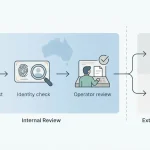
Verification can also hold up a first withdrawal. A specialist review describes identity checks that may ask you to submit a photo of an identity document and proof of your address, and may also request a selfie holding the document. Have both identity and address proof ready before requesting your first cash-out, and check that the submitted details match your account. If documents are incomplete, unclear or inconsistent, the review may take longer; a withdrawal request is not itself confirmation that verification has been completed.
Check these conditions separately: the game’s RTP setting concerns its theoretical return, the RNG determines each individual spin, and withdrawal terms and verification govern access to a balance after a win. None of them guarantees that you will win or that a particular amount will be paid by a particular date.
Casino in Brisbane: Hotels, Poker and Venue Details
Deposits, No-Deposit Claims and the Checks Before Withdrawal
A deposit method affects how funds reach an account; it does not establish whether a site is licensed, whether its games are fair, or whether a withdrawal will be paid. Treat the payment method and the operator’s terms as separate things to check.
A specialist review describes minimum deposits at many operators as AU$10 to AU$20, with some accepting AU$5. These are reported figures, not a promise that a particular site will accept that amount. Check the cashier’s current terms before sending money: the displayed minimum, available methods and any bank restrictions can differ.
A specialist review also reports that Australian banks and card companies are increasingly blocking transactions to known gambling sites. A declined payment may therefore reflect the bank or card issuer’s decision, rather than a problem with the details you entered. Do not keep retrying without checking with your provider; repeated attempts do not make a blocked transaction acceptable to the bank.
Card payments carry a separate cost risk. A specialist review notes that a bank or card issuer may classify a gambling deposit made with a credit or debit card as a cash advance. In that case, a fee of 3–5% and interest charged immediately may apply. The treatment depends on the provider and card terms, so check those terms before using a card rather than assuming the transaction will be processed as an ordinary purchase.
Some specialist reviews describe Skrill and Neteller as popular e-wallets, citing speed and relative anonymity. Those descriptions do not remove the need to check the conditions attached to the account and payment route. An e-wallet is a way to move funds; it is not evidence that the operator is trustworthy or that a withdrawal will succeed.
Do
- Check the current minimum deposit in the cashier
- Verify the identity documents required for withdrawal
- Read the full terms of no-deposit offers
Don’t
- Assume a payment method guarantees site licensing
- Keep retrying a transaction blocked by your bank
- Trust a headline offer without checking the conditions
The phrase “no-deposit” needs careful reading. It describes a claimed offer condition, not proof that you can withdraw money without checks or that a payout is assured. Read the offer terms to establish what qualifies, what conditions apply to any resulting balance, and whether the operator requires you to complete account verification before a first withdrawal. A headline alone does not answer those questions.
Before depositing, check that the payment method is available to you, what the minimum is, and whether your bank may reject the transaction or charge it differently. Before relying on a no-deposit offer, read its conditions and the withdrawal requirements alongside one another. The relevant test is not whether the wording sounds cost-free, but whether you understand what you must do before funds can leave the account.
Before your first withdrawal, verify the required documents: this includes proof of identity and proof of address. Complete those checks using the operator’s stated process and make sure the submitted details match your account. Payment approval and account verification are distinct steps; having a deposit accepted does not mean the verification needed for a withdrawal is already complete.
What “Australian” Means for Online Pokies
“ Australian” can describe the intended audience, the language and currency on a site, or the location of a player. It does not, by itself, describe the operator’s legal status. A site may accept people in Australia without holding an Australian licence; accepting Australian players is not proof that the service is licensed domestically.
Best Pokies in Adelaide: RTP and Venue Checks
The distinction matters because Australian law treats the operator’s conduct separately from a site’s marketing or accessibility. The Interactive Gambling Act 2001 prohibits operators from providing real-money online pokies to people physically in Australia without a domestic licence, and no Australian online casino licences have been issued. The legal age for gambling, including online pokies, is 18. Meeting that age threshold does not change whether an operator is authorised to provide the service.
The Australian Communications and Media Authority (ACMA) enforces the Act. Its role includes blocking access to illegal offshore gambling sites. Internet service providers must comply with ACMA’s blocklist, so an offshore site that was accessible at one time may later be blocked in Australia. A page loading, an account being offered, or a site displaying Australian-facing information does not establish that the operator has permission to serve Australian residents. Conversely, a block is an access measure; it does not turn the site into an Australian-regulated service.
BetStop has a narrower scope than its name may suggest. It applies to Australian-licensed operators and does not bind offshore casinos. If you have registered with BetStop, do not assume that an offshore site will check or enforce that exclusion. The existence of a self-exclusion tool on a particular site also does not establish that it is connected to BetStop or that the operator is Australian-licensed.
RTP Pokies in Australia: How Returns Work
When assessing what “Australian” means on a site, separate three questions: who the service is aimed at, whether it can be reached from Australia, and whether it holds a domestic licence. Those are not interchangeable signals. In this market, a local-facing interface or willingness to accept a player cannot supply the domestic authorisation that does not exist.
Pokies Apps: Separate the Interface from the Game
An app is a way to reach an online service; its label does not tell you whether the service is licensed to offer real-money pokies in Australia. Nor does an app’s appearance establish that a game is fair or reveal its return-to-player (RTP) setting. Treat the interface and the game as separate things to assess.
The interface is the layer you use to navigate the service: it presents menus, account information and game choices. The underlying pokie is a separate product with its own rules and settings. A polished interface cannot verify those settings, while a basic one does not by itself prove that a game is unreliable. Presentation is not evidence about how a game is configured.
Best pokies in Tasmania: checking venue details
RTP needs particular care because the same pokie may not have the same setting everywhere. A specialist review reports that some game providers allow casinos to select from multiple RTP settings for a given game. That means the title alone cannot establish which return percentage applies at a particular casino. If RTP information matters to your comparison, look for the setting stated for that specific game and service rather than relying on a figure attached to the game name in general.
An app label also does not establish who operates the service or what rules apply to it. Do not treat the word “Australian” in an app description, an Australian-facing design, or access from an Australian device as proof of Australian licensing. The interface can show what the service chooses to display, but its appearance is not a substitute for verifying the operator’s status.
When comparing an online pokies app, keep the questions distinct: can you understand the interface, and can you verify relevant information about the service and the particular game? Clear presentation may make details easier to find, but it does not make those details accurate or complete. Likewise, an app can provide access to a game without telling you which RTP setting is in use.
This distinction is useful whether you access pokies through an app or another interface. Evaluate what the interface communicates as interface information; evaluate game settings as game information. Neither conclusion follows from the app label alone.
Best Australian Pokies Online: Legal and Payment Guide
Mobile Play Does Not Change How a Spin Is Decided
Playing pokies on a phone changes the screen you use, not the basic meaning of an individual spin. Each spin is a separate random event determined by a Random Number Generator (RNG). The outcome of one spin does not tell you what the next spin will produce.
That independence matters when you play real-money pokies on a mobile device. A sequence of losses does not make a win due, and a recent win does not make another one more likely. The game does not build a predictable pattern from the results you have just seen. A run of similar outcomes can happen, but it does not provide evidence that the next result will continue or reverse that run.
The phone’s display shows the result after a spin; it does not give you a reliable way to forecast the next result. Watching animations, changing how quickly you tap, or switching between games cannot turn the previous outcomes into a prediction. The relevant point is the independence of each event, not the device used to start it.
This also sets a limit on what you can conclude from a short mobile session. A few spins cannot establish that a game is about to pay, is “cold”, or has changed its behaviour. Those descriptions treat a sequence as if it were a signal about the next event. With independent random outcomes, that conclusion does not follow.
If you are considering mobile pokies for real money in Australia, separate the convenience of using a phone from the mechanics of play. The mobile format may make a game accessible on a smaller screen, but it does not make outcomes more predictable. Treat each spin as its own random event, and do not use a previous result as a reason to expect a particular next one.
Sydney Casino Guide: Hotels, Dining and Visitor Details
Assessing New Sites Without Treating “New” as a Quality Signal
A site described as new tells you only how it is being presented; it does not establish that the operator is licensed to serve Australians, that withdrawals will be paid reliably, or that its pokies use a better return-to-player setting. The same caution applies when a new site advertises PayID. A payment option describes a way to transfer funds, not the operator’s status or the game’s configuration.
Check claims against details that can be inspected before you deposit. A specialist review reports that some game providers let casinos choose between multiple RTP settings for the same pokie. As a result, the title alone does not tell you which setting applies at a particular site. Look for the stated RTP for the specific game and site, and note whether the information identifies the setting rather than giving only a general game figure. If it is not clear, do not assume that a newly launched site offers the higher return.
Withdrawal conditions also matter more than a launch date. A specialist review says casinos may require identity checks before a first withdrawal, including proof of identity and address, and sometimes a selfie holding your ID. Read the operator’s stated requirements before depositing: you need to know what documents it expects and whether your details can be verified using them. A new brand name does not remove those checks or show how a withdrawal will be handled.
Treat “new” as a description, not a measure of quality. Compare the verifiable game setting and withdrawal requirements, and separate those details from promotional claims about freshness, payment choice or popularity. If important conditions are unclear, the label cannot fill the gap.
Casino Hotels and Facilities in Western Australia
PNG-Labeled Online Pokies and the Limits of the Available Evidence
A “PNG” label does not, by itself, identify who operates a pokie site, where its operator is based, or which authority—if any—has licensed it. It may be used to suggest a connection with Papua New Guinea or a particular audience, but that wording alone does not establish either. You need verifiable information about the specific operator and its legal status before drawing conclusions from the label.
That distinction matters for Australian residents. Under the Interactive Gambling Act 2001, companies may not offer real-money online pokies to people in Australia without a domestic licence. No domestic online-casino licences have been issued. A site’s use of a PNG-related name, its apparent availability, or its description of itself does not change that Australian legal position.
Nor does a geographic label establish that a site is licensed in the place it names. To assess a particular claim, look for the operator’s legal identity and the regulator it says issued its licence, then check whether that information can be independently confirmed. A location mentioned in promotional wording is not a substitute for a licence, and a licence claim would not amount to an Australian domestic licence.
The same caution applies to claims that a site is intended for Australian players or can pay them. Those statements do not verify the operator’s status or provide assurance about what would happen in a dispute. Treat “PNG” as a label requiring clarification, not as evidence of licensing, local approval, availability, or safety. For Australians, the relevant legal distinction remains whether a company is offering real-money online pokies without a domestic licence—not what regional wording appears in the site’s name.
Are online pokies legal for Australian players?
Yes, Australian players are not made liable simply for playing on an offshore site that accepts them. However, offering real-money online pokies to people in Australia without a domestic licence is prohibited, and no Australian online-casino licences have been issued.
What does “wagering requirement” actually mean?
It is the amount you must bet before bonus-related winnings can be withdrawn, usually expressed as a multiplier. For example, a $500 bonus with a 40x requirement means you must place $20,000 in bets.
Can casinos change the RTP of their games?
Yes. Some game providers let casinos choose between multiple RTP settings for the same pokie, so its return percentage can differ between casinos.
Pokies

3-Reel Slots in Australia: How Spins Work
This guide explains independent spin results, game formats, RTP checks, free-play options and restrictions affecting...

Five-Reel Slots in Australia: How They Work
A practical guide to reel layouts, bonus features, RTP, paytables and the differences between free...

Seven-Reel Slots in Australia: How They Work
Seven reels describe the screen, not a predictable outcome; RNG results are independent, while RTP...

Australian Online Pokies: Laws, Payments and Offers
A practical guide to Australian real-money rules, payment checks, bonus terms and the limits of...

Aussie Online Casinos: Legality, Offers and Payments
Understand how offshore access differs from Australian licensing, and what bonus conditions, payment methods and...

Aussie Pokies Online in Australia: Free vs Real Play
A practical guide to free and real-money pokies, payment limits, bonus conditions and the difference...

Best Australian Pokies Online: Legal and Payment Guide
A practical overview of legal status, game outcomes, payment issues, bonus terms, withdrawal checks and...

Bonus Buy Slots in Australia: How They Work
A clear look at feature entry, random outcomes, demo limits and the details to check...

Adelaide Casino: Rooms, Poker and Venue Details
A practical overview of accommodation, poker, dining, events and venue facilities, with guidance on confirming...

Casino in Brisbane: Hotels, Poker and Venue Details
Coverage distinguishes casino-operated stays from nearby hotels and outlines details to verify for bookings, poker,...

Canberra Casino: Hotel and Stay Details
A room listing does not confirm a casino connection; verify the accommodation provider, address and...

Darwin Casino Guide: Gaming, Dining and Entertainment
Assess the venue, activities and practical arrangements separately, and confirm services that may change before...

Hobart Casino Guide: Poker, Rooms and Facilities
An overview of poker arrangements, accommodation, dining and facilities, with a reminder to confirm current...

Melbourne Casino Guide to Games and Visitor Details
Separate game types from venue offerings and distinguish on-site gambling from the availability of online...

Casino in Perth: Hotel Stays, Dining and Visitor Details
Find practical information on accommodation, dining, entertainment, facilities and checking venue details before a visit....

Best Casino in Queensland: Hotels, Dining and More
An overview of hotel stays, dining, parking, entertainment and other practical questions about Queensland casino...

Sydney Casino Guide: Hotels, Dining and Visitor Details
Understand how casino and hotel arrangements differ, and what to verify in room listings, booking...

Casino Hotels in Tasmania: Stays, Dining and Venue Details
A practical guide to comparing casino accommodation with gaming, dining, facilities and other venue information...

Casino in Victoria: Hotels, Gaming and Dining
An overview of accommodation, gaming, food and practical details to verify when considering a casino...

Casino Hotels and Facilities in Western Australia
Casino stays pair accommodation with gaming, but room features, booking terms and on-site amenities need...

Fast payout online casinos in Australia: what to check
Withdrawal speed depends on operator processing, payment checks and bonus terms, while a fast claim...

High-Volatility Slots in Australia: How They Work
A guide to how random outcomes, payout frequency, and bankroll discipline shape the experience of...

Instant Payout Online Casinos in Australia: How It Works
A withdrawal moves from casino checks and approval to payment handling, so the advertised casino...

Live Casino Online in Australia: Games and Rules
This guide separates the streamed table experience from software data, payment terms and legal questions...

Live Dealer Casino Online in Australia: Access
Australian law, licensing limits and practical checks shape what can be confirmed about live-dealer sites,...

Low-volatility slots in Australia: what to know
Volatility describes the broader pattern of win size and frequency, not the outcome of any...

Keno Online Casinos in Australia: Laws and Checks
A guide to Australian law, payment and withdrawal checks, game formats, bonus terms and the...

Best Pokie Machine to Play in Australia: A Guide
See how game features, odds, demo play and practical limits can affect a pokie session...

Best Pokies in Adelaide: RTP and Venue Checks
RNG outcomes are random, while RTP describes a game's return over time; venue information and...

Best Pokies in Brisbane: Hours and Venue Checks
A practical guide to checking venue and gaming-area hours, online pokies’ legal position, and key...

Pokies in Canberra: How to Check Venue Access
Venue listings may confirm general opening hours without showing whether the gaming area is operating;...

Best Pokies in Geelong: Venue Hours and Checks
Venue opening hours do not always confirm that the gaming area or pokies will be...

Pokies in Melbourne: How to Compare Venues
Venue addresses, operating rules, machine return settings and travel routes offer different checks when comparing...

Pokies in New South Wales: Limits and Access
A practical guide to loss limits and checking what is known about pokie access at...

Pokies in Perth: What to Check Before Visiting
A venue’s listed hours may cover dining or other services, not necessarily access to its...

Best Pokies in South Australia: Venue and Play Checks
A practical guide to game features, venue checks, access planning and the limits of what...

Pokies in Sydney: Finding Venues and Online Play
Location searches can mean a nearby venue or online play, so the details behind each...

Best pokies in Tasmania: checking venue details
Venue listings, published hours and machine information each have limits when assessing availability and pokie...

Progressive Jackpot Slots: How Pools and Payouts Work
Progressive pools grow from qualifying wagers, while eligibility, trigger rules and payout structures vary between...

RTP Pokies in Australia: How Returns Work
RTP compares stakes with prizes over extended play, but settings can vary by casino and...

RTP Slots in Australia: Understanding Long-Run Returns
RTP is a long-run theoretical measure, so its percentage alone cannot predict session results or...

Video Slots in Australia: How Play and RTP Work
RNG outcomes, device controls, free-play limits and displayed RTP shape how online slots work across...

Big Red Pokies Online in Australia: Free Play
Free play shows the controls and sequence of actions, but each spin remains an independent...

Casino Dice Games in Australia: Rules and Formats
Casino dice games use physical or digital dice to settle wagers, with each format defining...

Crash casino games in Australia: rules and risks
Learn how rising multipliers, cash-out timing, Australian rules and payment conditions shape crash-game play. How...

Lightning Link Online Pokies in Australia: How It Works
Lightning Link is a series by Australian developer Aristocrat; individual versions and how they are...

Live Baccarat in Australia: Online Casino Access
A guide to Australian access, table formats, baccarat rules, odds and practical checks for comparing...

Live Blackjack Online Casinos in Australia: What to Know
Australia’s restrictions, live dealing, payment claims and gaps in blackjack-specific evidence shape a careful assessment....

Live Roulette in Australia: English-Speaking Dealers
This guide separates Australian rules for real-money online casinos from claims about dealers, wheels, odds,...

Mines Casino Game in Australia: Key Differences
Mines uses a minefield-style choice format, while pokies are electronic gaming machines with a different...

Most Trusted Online Casinos in Australia: Assessing Claims
A framework for weighing licensing, payments, bonus terms and game claims without treating operator statements...

Plinko Casino Australia: Games, Payments and Terms
A practical look at how game format, Australian access, payout conditions and bonus rules shape...

Pokies Tips and Tricks: What Players Should Know
Understand what random results, RTP and session limits mean—and why none of them can predict...

Real Money Casino Table Games in Australia
A practical guide to digital and live-dealer formats, game objectives, odds and the ways table-game...