Plinko Casino Australia: Games, Payments and Terms
 Available in AU

A practical look at how game format, Australian access, payout conditions and bonus rules shape what a Plinko casino label actually means.
Table of Contents
- How Plinko Slots Differ from Other Pokie Formats
- Online Access and Australia’s Regulatory Context
- Real-Money Play: Cashouts, Verification and Wagering
- Game Mechanics, Software and Jackpot Conditions
- What a Plinko Casino Review Can—and Cannot—Verify
- Plinko Casino in Australia: What the Name Does Not Tell You
- Free Play and the Difference Between Practice and Bonus Funds
- Crypto Payments and the Amount You Receive
- Bonus Terms: Wagering Multipliers and Game Contributions
- UK and Casino-Guru Searches: Check the Market Before Applying a Review
How Plinko Slots Differ from Other Pokie Formats
“Plinko” describes a style of game presentation; “pokie” describes a category of gambling game. The terms can overlap, but they answer different questions. A game may use a Plinko-inspired visual layout and still be classified and presented as a slot-style game. The name or appearance alone does not tell you how its software is categorised, or whether it is linked to a progressive jackpot.
The distinction matters because a familiar visual can suggest the wrong comparison. A Plinko-style screen may look unlike a conventional reel-based pokie: its central image may evoke a board, pegs and a falling object rather than spinning reels. But appearance is only one part of a game’s presentation. The product’s rules, software description and category determine how it is treated, not whether its screen resembles a traditional pokie.
Appearance is not the same as format
A slot-format game is not defined solely by reels on screen. Reel symbols are one common way of displaying a game, but software can present its play through other visual arrangements. A Plinko-themed title can therefore sit within a slot catalogue even if its imagery does not look like a standard reel game.
Choosing a Plinko casino in Australia means checking the details available before you decide where to play. Use this list as a concise reference to each operator’s stated licence, deposit minimum or payout timing.
1. Kingmaker
Payout speed: crypto ~90 minutes, fiat 1-5 days · Min. deposit: A$30 You can consider Kingmaker if payout timing matters: crypto payouts are listed at around 90 minutes, while fiat payouts take 1–5 days. The minimum deposit is A$30.
2. Neospin
License: Curacao Gaming Control Board OGL/2023/176/0095 (Hollycorn N.V.) You can note Neospin’s stated licence: Curacao Gaming Control Board OGL/2023/176/0095, held by Hollycorn N.V.
3. LevelUp Casino
License: Curacao eGaming OGL/2023/174/0082 (Dama N.V.) · Min. deposit: A$15 You can note LevelUp Casino’s Curacao eGaming licence, OGL/2023/174/0082, held by Dama N.V. Its minimum deposit is A$15.
4. Vegaz Casino
License: Curacao OGL/2024/1335/0780 · Min. deposit: EUR 20 You can note Vegaz Casino’s Curacao licence, OGL/2024/1335/0780. Its stated minimum deposit is EUR 20.
5. LuckyVibe
License: Curacao Gaming Control Board OGL/2023/176/0095 (Hollycorn N.V.) You can note LuckyVibe’s stated licence: Curacao Gaming Control Board OGL/2023/176/0095, held by Hollycorn N.V.
6. WinSpirit Casino
License: Curacao eGaming OGL/2024/923/0383 (Antillephone N.V.) · Min. deposit: A$30 You can note WinSpirit Casino’s Curacao eGaming licence, OGL/2024/923/0383, held by Antillephone N.V. Its minimum deposit is A$30.
7. Golden Pokies
License: Curacao The available detail for Golden Pokies is its Curacao licence, which you can take into account when reviewing the operator.
8. House of Pokies
License: international iGaming licence – jurisdiction not named in the source · Payout speed: PayID 1-24 hours · Min. deposit: A$30 (PayID from A$10) You can consider House of Pokies if PayID details are relevant: the listed payout time is 1–24 hours, with a A$30 minimum deposit or A$10 when using PayID. Its source describes the licence as an international iGaming licence without naming the jurisdiction.
9. Thor Casino
License: Curacao – Antillephone N.V. (Versus Odds B.V.) · Min. deposit: EUR 20 You can note Thor Casino’s Curacao licence with Antillephone N.V. (Versus Odds B.V.). Its minimum deposit is EUR 20.
10. Lucky Dreams
License: Curacao · Min. deposit: A$20 (POLi) You can note Lucky Dreams’ Curacao licence. Its stated minimum deposit is A$20 when using POLi.
The reverse is also important: a board-like image does not automatically make a game a standalone board game, a skill game or a separate gambling category. Those labels require more than a visual resemblance. To identify the format, look for the game’s own description and rules rather than inferring its category from graphics, animation or title.
This gives you a practical way to read a product page. Separate the name and artwork from the classification information. “Plinko” may indicate a theme or presentation, while “slot” identifies how the product is grouped. If a page uses both terms, it may simply be describing a Plinko-style slot game; the wording does not establish that it belongs to a jackpot network or has a particular payout structure.
A slot label does not mean a progressive jackpot
A progressive jackpot is a feature of a prize structure, not a synonym for a slot. In a progressive arrangement, the jackpot grows as players use linked machines or a network of pokies. That growth may occur within one machine or across a wider group. The fact that a game is called a slot does not, by itself, show that either arrangement applies.
There are two broad forms to distinguish. A standalone progressive is tied to an individual machine or local game setup. A networked progressive draws on linked machines or a broader network. Both are still jackpot arrangements; neither is a basic definition of the slot format. A game can be a slot without a progressive jackpot, and the word “progressive” does not tell you whether the game’s screen uses reels, a Plinko-style layout or another presentation.
Lightning Link Online Pokies in Australia: How It Works
This distinction prevents a common category error: treating “slot” and “progressive” as competing labels. One describes the game format; the other describes how a jackpot can accumulate across play. A product description might use both because a slot-format game also has a progressive prize, but one term does not prove the other.
What the category can—and cannot—tell you
Calling a product a Plinko slot tells you how it is being framed in a game catalogue, not every detail of its operation. It does not establish the game’s exact rules, the software provider, its return percentage or whether a jackpot is attached. Those details need to be checked separately in the game information. A category label is a starting point for identification, not a substitute for the rules.
Return-to-player figures are another separate property. For example, KA Gaming slot RTP percentages typically fall within a range from 94% to 96%. That range applies to KA Gaming slots as a group; it does not identify the RTP of every Plinko-themed title or establish that a particular Plinko game comes from that provider. Provider, title and game configuration all matter when matching a figure to a specific product.
The same care applies to words such as “machine”. A “Plinko slot machine” may be shorthand for a slot-style game with Plinko imagery, rather than a claim that the product is a physical cabinet or a progressive jackpot machine. The phrase describes an impression unless the product details clarify the actual format. Do not infer a network connection, jackpot feature or physical machine from the wording alone.
When you compare a Plinko-style title with other pokie formats, keep three questions separate: how the game is categorised, how its visual interface presents play, and whether its prize structure includes a progressive jackpot. Treating those as distinct properties makes the terminology easier to interpret. A game may look unlike a reel pokie yet be listed as a slot; it may be a slot without a progressive; and a progressive may be local or networked. The label is useful, but only within those limits.
Hobart Casino Guide: Poker, Rooms and Facilities
Online Access and Australia’s Regulatory Context
A Plinko game appearing on a website does not establish that the service may lawfully be offered to people in Australia. A page may load, display a game or accept an account registration while still relating to a service that Australian law prohibits operators from providing here. Technical access and legal permission are separate questions: the first concerns whether a site can be reached; the second concerns what the operator is allowed to offer to people physically located in Australia.
The Interactive Gambling Act 2001 restricts operators from providing real-money online casino games to people in Australia. That category includes casino-style games such as slots, poker, blackjack and roulette. Describing a game as Plinko, presenting it as a pokie, or placing it inside a wider casino website does not by itself change the legal classification of the service. The relevant issue is the real-money online gambling service being offered, not the label used on its page.
This distinction matters because an online casino with Plinko may be accessible from an Australian internet connection without being authorised to provide that casino service in Australia. A functioning site, an Australian-facing page or a game that opens in a browser is evidence of availability in a technical sense only. It should not be treated as evidence that the operator has permission under Australian law. The same distinction applies when the game is described as live or online: those descriptions explain how it is presented, not whether its provision to Australian users is lawful.
ACMA’s role and website blocking
The Australian Communications and Media Authority (ACMA) oversees compliance with federal interactive gambling rules and enforces the Interactive Gambling Act 2001. Its work includes taking action in relation to prohibited services offered to people in Australia. ACMA can ask Australian internet service providers to block websites that provide prohibited interactive gambling services or advertise them here. The request is an enforcement measure aimed at restricting access to identified sites; it is not a licensing process and does not turn other reachable sites into permitted services.
ACMA Enforcement
Since November 2019, the Australian Communications and Media Authority has blocked more than 1,455 illegal gambling and affiliate websites.
ACMA says that, following enforcement action, it has blocked more than 1,455 illegal gambling and affiliate websites since November 2019. The figure covers both gambling sites and affiliate websites, so it should not be read as a count of Plinko sites alone. Nor does a block count tell you that every prohibited site has been identified or that every site not appearing in a block action may legally serve Australian users. It describes enforcement activity, not a complete register of lawful operators.
There is also a reported difference in the number of illegal services that have left the Australian market since ACMA began enforcing the rules in 2017. One account puts the total at more than 210, while another reports over 190. Those figures should not be combined or presented as if they were the same count. The central point is that enforcement has led some services to withdraw; the differing totals are not a way to determine whether a particular site is lawful or available.
Blocking can affect what you can reach through an Australian internet provider, but access conditions alone do not settle the legal question. A site may be unavailable because access has been restricted, while another may remain reachable without that fact establishing that it can legally offer online casino games in Australia. Website availability can also change over time. For that reason, the appearance of a Plinko casino game online should not be treated as a regulatory status check.
The legal responsibility described here concerns the operator’s provision of the service. Australian players are not criminalised simply for using an offshore gambling site. That does not mean the service itself is permitted to provide real-money online casino games to people in Australia, nor does it remove the practical uncertainty that can follow when a site is blocked or otherwise becomes inaccessible.
Best Pokies in Geelong: Venue Hours and Checks
When assessing an online Plinko offering from Australia, keep the questions separate: whether the page or game can be reached, and whether the operator may lawfully provide the service to people located here. ACMA’s blocking activity demonstrates that accessibility is not guaranteed, while the Interactive Gambling Act establishes the restriction on operators. Neither a game’s presence on a website nor its Australian-facing presentation answers both questions.
Real-Money Play: Cashouts, Verification and Wagering
A withdrawal is not determined only by the balance displayed on an account. The amount you can request may depend on whether your identity has been checked, whether the request meets the stated minimum, and whether any bonus-related conditions have been completed. These are separate checks: passing one does not necessarily mean the others are complete.
KYC before a first cashout
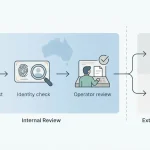
A first withdrawal commonly triggers KYC, meaning the account holder must provide documents that establish identity and, in some cases, address. Examples include a passport or driver’s licence and a utility bill. The account details and submitted documents need to correspond; a mismatch can leave the request pending while the operator asks for clarification or further evidence.
It helps to understand the sequence. You submit a withdrawal request, the operator checks the account and documents, and the payment is processed if the request meets the account’s conditions. If KYC has not been completed, a displayed balance does not by itself show that the funds are ready to leave the account. The operator’s terms should explain what documents it accepts and how it handles a request that cannot be verified.
Withdrawal Sequence
Step 1: Submit Request
You submit a withdrawal request for the funds in your account.
Step 2: Account Verification
The operator checks your account and your KYC documents (such as a passport or utility bill) for consistency.
Step 3: Processing
If the request meets all account conditions and identity is verified, the payment is processed.
Document checks can also affect timing without changing the amount shown in the balance. For example, an unclear image or inconsistent account information may require a new submission. Before relying on a stated processing period, check whether it begins when you submit the request or only after the verification and account checks are complete. Do not assume those stages are simultaneous.
Minimum withdrawal thresholds
Offshore sites commonly set minimum withdrawal thresholds in the range of A$75–A$150. A request below the applicable threshold may not be accepted, even when the account shows a positive balance. The specific threshold is an account term, so check it before making decisions about a withdrawal.
A threshold can also affect how much you need to request at one time. If your available balance is below the minimum, the site’s rules may prevent a withdrawal request for that amount. If the balance is above it, the threshold still does not guarantee payment: KYC and any applicable wagering checks remain separate conditions. Read the withdrawal rules for the account rather than assuming that a general range establishes the limit that applies.
Also distinguish the minimum request from any payment or processing rule. A threshold describes the amount needed to submit a request; it does not, by itself, describe how long processing takes or whether the full displayed balance is eligible. Keeping those questions separate makes the terms easier to interpret.
Best Pokies in South Australia: Venue and Play Checks
Bonus-related wagering checks
Where a balance includes winnings derived from a bonus, the operator may require wagering checks before allowing withdrawal. Such checks link eligibility to the amount wagered under the bonus rules, rather than simply to the amount visible in the account. A specialist review has reported wagering requirements in the 30–50x range, but that is a source-specific description, not a universal rule. The terms attached to the particular bonus and account determine what applies.
Check how the requirement is calculated: the rules may identify a bonus amount or another basis, and may specify which activity counts toward completion. A displayed balance can therefore contain funds that are not yet withdrawable. If the terms do not make the calculation clear, you cannot infer from the balance alone how much wagering remains.
The wording matters. A multiplier is not a fee deducted from the balance; it is a condition expressed through required wagering. Whether the requirement has been met is a separate question from whether the account has passed KYC or reached the minimum withdrawal threshold. Each condition should be checked independently.
A practical check before requesting funds
Before submitting a cashout request, confirm the available balance, the minimum withdrawal amount, the KYC documents required for a first cashout, and whether bonus-derived funds remain subject to wagering. Then compare the account’s status with the relevant terms. If a request is delayed, identify which condition is unresolved rather than treating every delay as the same problem.
Cashout Readiness
- Confirm the current available balance
- Check the minimum withdrawal amount
- Prepare required KYC documents for first cashout
- Verify if bonus funds are subject to wagering
This distinction is useful when assessing claims about a Plinko casino game involving real-money balances: an advertised payment method or a visible balance does not establish that a particular amount is ready to withdraw. The actual outcome depends on the account’s applicable conditions and completion of the required checks.
Game Mechanics, Software and Jackpot Conditions
A Plinko casino game can look simple on screen: a ball drops through pegs and lands in a position associated with a result. That visible path is only the interface. The software determines how outcomes are generated and displayed, while the game’s published rules explain what the displayed figures mean. If a jackpot is attached, its rules add a separate layer: they determine how the prize grows and which bets qualify.
Start by identifying the game and its provider. The provider matters because return-to-player figures are tied to particular software and game configurations, not to the general idea of Plinko or to a casino’s branding. KA Gaming slot RTP percentages typically range from 94% to 96%. That range is useful as a provider-level reference, not as a promise that every KA Gaming title uses the same setting. Check the information for the specific game rather than transferring a figure from another title.
RTP is a theoretical return calculated over extended play. It does not predict what a particular sequence of rounds will return, and it does not mean that a player will receive a set proportion of their stake. Short sessions can produce results far from the published figure. The number also says nothing by itself about jackpot eligibility: a game can display an RTP while applying separate conditions to a progressive prize.
Keno Online Casinos in Australia: Laws and Checks
A progressive jackpot is funded to grow as play takes place across the machines or games connected to it. The scope of that connection changes how the jackpot is structured. A standalone progressive is local to a particular machine or game, so its growth is associated with that individual unit. A networked progressive links many machines or games, potentially across an operator’s wider fleet; contributions from connected play feed the shared prize. The displayed total should therefore be read alongside the stated jackpot type. A large-looking amount alone does not tell you which games contribute to it or who can qualify.
The contribution rate describes how much of eligible play is directed towards the progressive pool. It is not necessarily the same as the game’s RTP, and it does not mean that an individual bet will increase the displayed jackpot by a visible amount. A specialist review describes jackpot qualification as depending on contribution and minimum-bet conditions. Those conditions are specific to the game and jackpot, so inspect the rules attached to the title rather than assuming that every bet contributes or qualifies.
The minimum bet is especially important. Some games require a qualifying stake before a player can enter the jackpot feature; A$1.00 is an example of such a threshold, not a universal rule. A lower bet may still play the base game without meeting the jackpot condition. If the rules do not make the threshold clear, the jackpot display alone cannot establish that a given stake qualifies.
Melbourne Casino Guide to Games and Visitor Details
Check whether eligibility applies automatically or only to certain bet settings, and whether the jackpot belongs to the game itself or to a linked network. Also distinguish the base-game return figure from any jackpot amount shown separately. If a published RTP excludes a progressive component, the displayed RTP and jackpot should not be treated as one combined measure unless the game rules explain that calculation.
These details let you predict what changes when you alter a stake: the base game may continue, but jackpot eligibility or contribution may differ. The software’s rules—not the Plinko label, visual animation or headline prize—determine how the game operates.
What a Plinko Casino Review Can—and Cannot—Verify
A useful Plinko casino review checks claims that can be inspected: the game’s displayed rules, the identity of its software provider, and the payment terms presented to account holders. It can compare those details with the operator’s published conditions and point out where wording is unclear. It cannot establish that a player will win, predict how a session will end, or turn a product description into evidence of safety.
That distinction matters when a game is presented under a casino brand or a promotional name. A review can describe what the interface says and whether its stated rules are consistent across the game and its terms. It should not imply that branding, a celebrity association, or a polished presentation verifies an endorsement or guarantees a particular result. Nor does a favourable review establish that a service is suitable for every reader.
Live Casino Online in Australia: Games and Rules
Payment information is also something to assess as written, not as a promise. A reviewer can check whether the operator explains its payment methods and conditions clearly. That does not prove that a future transaction will proceed without delay or that the amount received will match a player’s expectation. Keep claims tied to what the review can actually observe, and treat missing or ambiguous terms as uncertainty rather than filling the gap with reassurance.
Product-level checks do not capture the wider effects of gambling. A report published by gamble.com.au put Victorian poker-machine losses at $2.6 billion over the year it covered, which was more than $44.7 million above the figure it gave for 2015. The same report said the Epping Plaza Hotel in Melbourne’s north generated more than $21 million from 100 machines during the year it examined. Those figures describe reported losses and venue revenue; they are not a forecast for an individual player or a measure of what any one game will produce.
Public debate about reform addresses a different question from a game review. Senator Nick Xenophon and MP Andrew Wilkie put forward a proposal to cap poker-machine bets at $1. A proposed limit is evidence of a policy debate, not proof that a particular product has that limit or that the proposal became a rule.
No review should present gambling as income or encourage you to recover losses by continuing to play. You must be at least 18 to gamble, and gambling can cause serious harm, particularly for vulnerable people. A review can help you separate checkable product descriptions from assumptions; it cannot remove that risk or establish a safe outcome.
Legal Warning
Under the Interactive Gambling Act 2001, operators are prohibited from providing real-money online casino services to people located in Australia.
Plinko Casino in Australia: What the Name Does Not Tell You
A name such as “Plinko Casino” describes branding, not legal status. Adding Australian flags, local currency or references to Australian players does not show that an operator holds an Australian gambling licence, nor does it establish that the service may lawfully offer online casino games to people in Australia.
The relevant distinction is between where an operator is licensed and where it is permitted to provide a service. Offshore online casinos may accept Australian payments while operating under licences issued elsewhere. An offshore licence concerns the operator’s status in that jurisdiction; it does not override Australian law. Under the Interactive Gambling Act 2001, operators are restricted from offering online casino services to people in Australia.
That distinction matters even when a site presents a polished Australian-facing experience. A local payment option, Australian-dollar display or country-specific page can indicate that the operator is trying to serve the market, but none of these details proves that the service is lawful here. Nor does the word “casino” in a brand name identify the authority responsible for licensing it.
The same principle applies to Plinko-branded games. A game title or casino label cannot determine whether the operator may offer online casino play in Australia. You need to separate the identity of the product from the legal position of the service providing it. A familiar name, a professionally designed site and an offshore licence are not substitutes for permission under Australian law.
The legal restriction is directed at operators providing prohibited online casino services, not at players as criminals for using offshore sites. That distinction does not make the service lawful or turn its branding into evidence of Australian authorisation. It simply separates the operator’s obligations from the position of an individual player.
If you are assessing a casino that presents itself as Australian, treat its name and localised features as marketing information only. They cannot establish that the operator may legally provide online casino games to people in Australia. The meaningful question is not whether the site looks Australian, but whether the service is permitted to operate for people located here. Under the Australian framework, an offshore licence alone does not answer that question in the operator’s favour.
Pokies in Melbourne: How to Compare Venues
Free Play and the Difference Between Practice and Bonus Funds
“Free play” can describe more than one arrangement. In a practice mode, you use no deposited money and receive no cashable balance. The play may let you learn how a Plinko-style game behaves, but a practice result is not a payout and does not establish that any real-money version is available to you.
Promotional spins or a bonus balance are different. They may be provided without an initial deposit, but that does not make any resulting balance cash. The terms can attach wagering requirements to bonus-derived winnings, meaning you must place qualifying bets before those winnings become withdrawable. The distinction is about the funds and their conditions, not simply whether you paid to start.
A specialist review, for instance, describes a $100 bonus with a 40x wagering requirement as requiring $4,000 in bets before bonus-derived winnings can be withdrawn. That is a specific example reported by that type of source, not a universal rule. The calculation illustrates the mechanism: the multiplier applies to the stated bonus amount, and the resulting betting volume is a condition rather than a fee or guaranteed path to a payout.
When you see a “free” label, check what it refers to: a no-stake practice mode, promotional spins, or bonus funds subject to conditions. Read whether winnings from spins are credited as cash or as bonus funds, what wagering applies, and whether the terms impose other limits. If those details are unclear, the word “free” alone tells you little about what you can keep.
A practice mode can be useful for understanding controls and game flow, but it cannot show how bonus conditions would affect a cash balance. And a bonus should not be treated as income or as a reason to continue gambling. Gambling can cause serious harm, particularly for vulnerable people; anyone considering gambling must be at least 18.
Crypto Payments and the Amount You Receive
A crypto withdrawal can clear quickly without delivering the full amount shown before it is sent. A specialist review describes crypto withdrawals as often clearing fastest, while noting that network fees and conversion spreads can reduce what reaches the recipient. These are separate costs: one is associated with processing a blockchain transaction; the other arises when value is converted between currencies or assets.
Fast payout online casinos in Australia: what to check
The amount displayed at the start is therefore not necessarily the amount received. If a fee is deducted from the transfer, the recipient gets less than the stated withdrawal value. If conversion occurs at a rate that includes a spread, the resulting value can also be lower than a calculation using a reference exchange rate would suggest. Where both apply, their effects can compound.
Before relying on a quoted crypto amount, check which asset the figure refers to, whether the displayed value is before or after fees, and whether conversion is involved. Also check which network is used: a crypto asset may be transferable across different networks, and the network selected affects how the transaction is processed. A fast processing estimate does not answer these cost questions.
The same checks matter when a service describes itself as a Plinko casino that accepts crypto. The label does not tell you whether the displayed withdrawal figure is a nominal amount, a converted estimate or the amount expected to arrive after deductions. A script or payment interface can present a number clearly while leaving the calculation behind it unclear. Look for terms that explain the fee and conversion method, rather than treating speed as evidence that the full stated value will be received.
For a useful comparison, follow the amount through each step: the value requested, any network charge, any conversion rate applied and the final amount delivered. If the terms do not show how these figures relate, the net amount cannot be predicted from the headline withdrawal value alone.
Bonus Terms: Wagering Multipliers and Game Contributions
A bonus multiplier is a calculation, not a description of how many rounds you must play. If the terms apply a 40x requirement to a $100 bonus, the required turnover is $4,000 in qualifying bets before winnings derived from that bonus can be withdrawn. A specialist review gives this as an example; it should not be treated as a universal offer or a standing rule. The operator’s own terms determine which funds the multiplier applies to and what counts toward it.
Bonus funds are not cash. They remain subject to the stated conditions, and a displayed balance does not by itself mean the amount is withdrawable. For a no-deposit offer, check whether the multiplier applies to the bonus, any winnings, or both. Also check for expiry rules, excluded games and maximum-bet conditions; each can affect whether your bets count. Do not assume that a bonus attached to a game called Plinko, or to a title such as Gods of Plinko, has terms identical to another offer.
Contribution rates make the calculation less direct. If a game contributes only part of each stake to turnover, the full amount wagered does not advance the requirement. A specialist review has reported blackjack contributing 10% toward wagering requirements. Under that stated rate, a $10 blackjack bet would add $1 to qualifying turnover, rather than $10. That example describes the effect of a contribution rate; the rate and eligible games must be checked in the specific terms.
Read the multiplier and contribution rules together. A large headline bonus can still require substantial qualifying turnover if only a fraction of each bet counts. Terms aimed at players in another market, such as the Netherlands, do not establish that an offer is available or lawful in Australia. Online casino services are prohibited for people physically located in Australia, and bonus wording does not change that. Any gambling is restricted to adults aged 18 or older.
UK and Casino-Guru Searches: Check the Market Before Applying a Review
A page about a Plinko casino aimed at UK readers may appear alongside material for Australian readers. That does not show that its details apply in Australia. The country in a page title or description is a clue to its intended audience, not proof of where a service is available or which terms govern it.
The same caution applies when Casino Guru is mentioned. A reference to a review platform does not establish that it has assessed the particular service you are considering, or that any assessment covers Australian access. Check what the page actually identifies: the operator, the game, the date of the assessment and the market it addresses. If those details are absent or do not match, its conclusions may not answer your question.
A name such as Lucky Plinko also needs context. A matching name in a page title, game description or promotional material is not enough to confirm that each reference concerns the same product or operator. Look for specific identifying details rather than treating similar wording as proof of a connection.
Before applying any review to your own situation, separate three things: what game is being discussed, which service or operator is being assessed, and which audience the information is intended for. Then check whether the page explains the basis for its claims and whether its information is current. A rating or summary without that context can create confidence without resolving the practical question.
These checks do not establish that a service is suitable or available to Australians. They help you identify when information is about a different market, a different entity or a different product, and avoid treating a familiar name as evidence.
Pokies

3-Reel Slots in Australia: How Spins Work
This guide explains independent spin results, game formats, RTP checks, free-play options and restrictions affecting...

Five-Reel Slots in Australia: How They Work
A practical guide to reel layouts, bonus features, RTP, paytables and the differences between free...

Seven-Reel Slots in Australia: How They Work
Seven reels describe the screen, not a predictable outcome; RNG results are independent, while RTP...

Australian Online Pokies: Laws, Payments and Offers
A practical guide to Australian real-money rules, payment checks, bonus terms and the limits of...

Aussie Online Casinos: Legality, Offers and Payments
Understand how offshore access differs from Australian licensing, and what bonus conditions, payment methods and...

Aussie Pokies Online in Australia: Free vs Real Play
A practical guide to free and real-money pokies, payment limits, bonus conditions and the difference...

Best Australian Pokies Online: Legal and Payment Guide
A practical overview of legal status, game outcomes, payment issues, bonus terms, withdrawal checks and...

Bonus Buy Slots in Australia: How They Work
A clear look at feature entry, random outcomes, demo limits and the details to check...

Adelaide Casino: Rooms, Poker and Venue Details
A practical overview of accommodation, poker, dining, events and venue facilities, with guidance on confirming...

Casino in Brisbane: Hotels, Poker and Venue Details
Coverage distinguishes casino-operated stays from nearby hotels and outlines details to verify for bookings, poker,...

Canberra Casino: Hotel and Stay Details
A room listing does not confirm a casino connection; verify the accommodation provider, address and...

Darwin Casino Guide: Gaming, Dining and Entertainment
Assess the venue, activities and practical arrangements separately, and confirm services that may change before...

Hobart Casino Guide: Poker, Rooms and Facilities
An overview of poker arrangements, accommodation, dining and facilities, with a reminder to confirm current...

Melbourne Casino Guide to Games and Visitor Details
Separate game types from venue offerings and distinguish on-site gambling from the availability of online...

Casino in Perth: Hotel Stays, Dining and Visitor Details
Find practical information on accommodation, dining, entertainment, facilities and checking venue details before a visit....

Best Casino in Queensland: Hotels, Dining and More
An overview of hotel stays, dining, parking, entertainment and other practical questions about Queensland casino...

Sydney Casino Guide: Hotels, Dining and Visitor Details
Understand how casino and hotel arrangements differ, and what to verify in room listings, booking...

Casino Hotels in Tasmania: Stays, Dining and Venue Details
A practical guide to comparing casino accommodation with gaming, dining, facilities and other venue information...

Casino in Victoria: Hotels, Gaming and Dining
An overview of accommodation, gaming, food and practical details to verify when considering a casino...

Casino Hotels and Facilities in Western Australia
Casino stays pair accommodation with gaming, but room features, booking terms and on-site amenities need...

Fast payout online casinos in Australia: what to check
Withdrawal speed depends on operator processing, payment checks and bonus terms, while a fast claim...

High-Volatility Slots in Australia: How They Work
A guide to how random outcomes, payout frequency, and bankroll discipline shape the experience of...

Instant Payout Online Casinos in Australia: How It Works
A withdrawal moves from casino checks and approval to payment handling, so the advertised casino...

Live Casino Online in Australia: Games and Rules
This guide separates the streamed table experience from software data, payment terms and legal questions...

Live Dealer Casino Online in Australia: Access
Australian law, licensing limits and practical checks shape what can be confirmed about live-dealer sites,...

Low-volatility slots in Australia: what to know
Volatility describes the broader pattern of win size and frequency, not the outcome of any...

Keno Online Casinos in Australia: Laws and Checks
A guide to Australian law, payment and withdrawal checks, game formats, bonus terms and the...

Best Pokie Machine to Play in Australia: A Guide
See how game features, odds, demo play and practical limits can affect a pokie session...

Best Pokies in Adelaide: RTP and Venue Checks
RNG outcomes are random, while RTP describes a game's return over time; venue information and...

Best Pokies in Brisbane: Hours and Venue Checks
A practical guide to checking venue and gaming-area hours, online pokies’ legal position, and key...

Pokies in Canberra: How to Check Venue Access
Venue listings may confirm general opening hours without showing whether the gaming area is operating;...

Best Pokies in Geelong: Venue Hours and Checks
Venue opening hours do not always confirm that the gaming area or pokies will be...

Pokies in Melbourne: How to Compare Venues
Venue addresses, operating rules, machine return settings and travel routes offer different checks when comparing...

Pokies in New South Wales: Limits and Access
A practical guide to loss limits and checking what is known about pokie access at...

Pokies in Perth: What to Check Before Visiting
A venue’s listed hours may cover dining or other services, not necessarily access to its...

Best Pokies in South Australia: Venue and Play Checks
A practical guide to game features, venue checks, access planning and the limits of what...

Pokies in Sydney: Finding Venues and Online Play
Location searches can mean a nearby venue or online play, so the details behind each...

Best pokies in Tasmania: checking venue details
Venue listings, published hours and machine information each have limits when assessing availability and pokie...

Progressive Jackpot Slots: How Pools and Payouts Work
Progressive pools grow from qualifying wagers, while eligibility, trigger rules and payout structures vary between...

Real-Money Online Pokies in Australia: Legal Guide
The guide separates operator restrictions from player liability and explains how payments, wagering terms and...

RTP Pokies in Australia: How Returns Work
RTP compares stakes with prizes over extended play, but settings can vary by casino and...

RTP Slots in Australia: Understanding Long-Run Returns
RTP is a long-run theoretical measure, so its percentage alone cannot predict session results or...

Video Slots in Australia: How Play and RTP Work
RNG outcomes, device controls, free-play limits and displayed RTP shape how online slots work across...

Big Red Pokies Online in Australia: Free Play
Free play shows the controls and sequence of actions, but each spin remains an independent...

Casino Dice Games in Australia: Rules and Formats
Casino dice games use physical or digital dice to settle wagers, with each format defining...

Crash casino games in Australia: rules and risks
Learn how rising multipliers, cash-out timing, Australian rules and payment conditions shape crash-game play. How...

Lightning Link Online Pokies in Australia: How It Works
Lightning Link is a series by Australian developer Aristocrat; individual versions and how they are...

Live Baccarat in Australia: Online Casino Access
A guide to Australian access, table formats, baccarat rules, odds and practical checks for comparing...

Live Blackjack Online Casinos in Australia: What to Know
Australia’s restrictions, live dealing, payment claims and gaps in blackjack-specific evidence shape a careful assessment....

Live Roulette in Australia: English-Speaking Dealers
This guide separates Australian rules for real-money online casinos from claims about dealers, wheels, odds,...

Mines Casino Game in Australia: Key Differences
Mines uses a minefield-style choice format, while pokies are electronic gaming machines with a different...

Most Trusted Online Casinos in Australia: Assessing Claims
A framework for weighing licensing, payments, bonus terms and game claims without treating operator statements...

Pokies Tips and Tricks: What Players Should Know
Understand what random results, RTP and session limits mean—and why none of them can predict...

Real Money Casino Table Games in Australia
A practical guide to digital and live-dealer formats, game objectives, odds and the ways table-game...