iPAY9 Withdrawals in Australia: Methods, KYC and Checks
 Available in US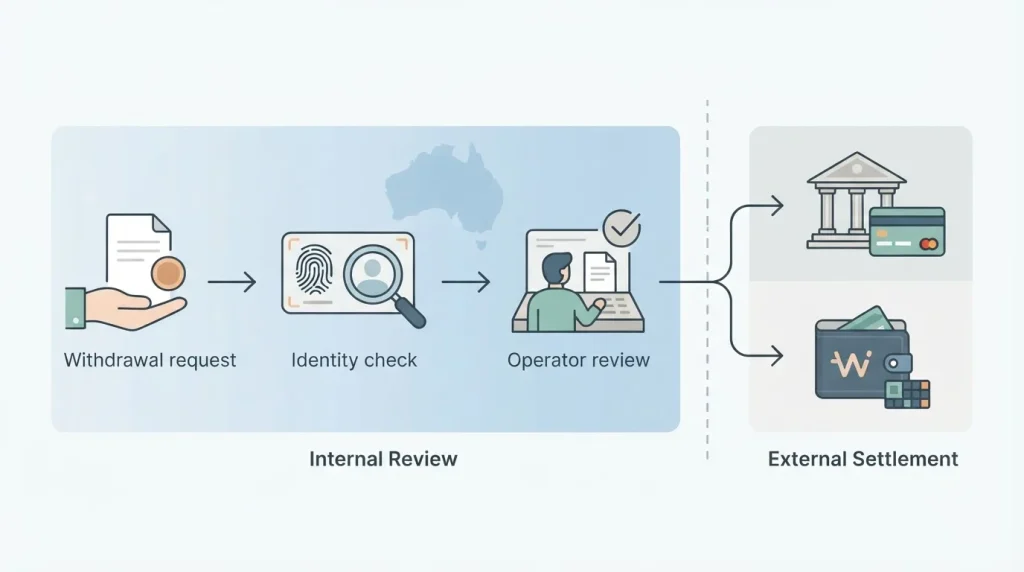
iPAY9’s current Australia-facing site states that withdrawals can be requested through linked bank accounts and that the platform supports crypto as a payment category. Those facts do not establish one fixed withdrawal time, fee or limit. Exact cashout conditions should be checked in the current account and official terms when you request a withdrawal.
Identity verification can also affect the cashout process. The available evidence supports that verification is part of the account flow, but it does not safely establish a universal document list or a guaranteed review time. A useful way to assess an iPAY9 withdrawal is therefore to separate four stages: the withdrawal request, any required identity check, operator review, and settlement through the selected payment route.
Table of Contents
- Which withdrawal routes are verified?
- The four stages that can affect a cashout
- Why there is no fixed withdrawal-time claim here
- Where KYC fits into an iPAY9 withdrawal
- Separate KYC delay from bank or crypto delay
- Before you request a withdrawal
- Bank-account withdrawals
- Crypto withdrawals
- What to do if a withdrawal is pending
- When a payout issue becomes a trust question
- Withdrawal troubleshooting by stage
- Withdrawal checklist for Australian users
- Bottom line
- iPAY9 Payments in Australia: Deposits, PayID and Withdrawals
Which withdrawal routes are verified?
The AU-facing iPAY9 site explicitly says withdrawals can be requested through linked bank accounts. It also confirms crypto support at platform level. This page does not turn those broad statements into an exact withdrawal menu, because the method shown to a specific account can depend on the live cashier and account state.
| Route | What is supported | What needs a live check |
|---|---|---|
| Linked bank account / bank transfer | The AU-facing site states that withdrawals can be requested through linked bank accounts | Availability for your account, bank-detail requirements, any displayed fee, limit and processing estimate |
| Crypto | Crypto is a verified payment category | Whether withdrawal is enabled, supported asset and network, wallet rules, displayed limits and transaction conditions |
For the broader funding picture, see the payment overview. Deposit mechanics are handled separately because a method used to add funds does not automatically define the withdrawal route.
The four stages that can affect a cashout
Withdrawal complaints often compress several different delays into one number. That makes anecdotal payout times hard to interpret. A more useful model separates the process into stages.
- Request. You submit the amount and destination in the cashier. The request can fail immediately if required fields or account conditions are not satisfied.
- Verification. The account may need identity or payment ownership checks. This is distinct from the payment network itself.
- Operator review. The withdrawal can remain pending while the platform reviews the request, account status or transaction history.
- Payment settlement. After release, the bank or blockchain route has its own processing behaviour outside the operator’s internal review.
If somebody says a withdrawal took a particular number of hours or days, that report does not tell you which stage consumed the time. That is why user anecdotes can reveal that experiences vary but cannot safely establish a universal iPAY9 withdrawal term.
Why there is no fixed withdrawal-time claim here
Exact withdrawal processing times are high-risk details because they can change by method and current terms. The current public iPAY9 pages available for this review do not provide sufficiently reliable official evidence for a single exact time that can be applied to Australian users. The same applies to exact fees and periodic withdrawal limits.
Instead of replacing missing primary evidence with an affiliate claim, check the live withdrawal screen when the value matters. If the account presents a processing estimate, fee or limit, treat that displayed information as more current than a static review. If no value is shown, support can clarify the current account-specific requirement.
Where KYC fits into an iPAY9 withdrawal
Identity verification is part of the account flow and can affect whether a withdrawal moves forward. The safe practical assumption is not that one document set always applies, but that the casino can require the account holder to complete the verification presented in the official account interface.
This page deliberately does not list exact iPAY9 KYC documents or a fixed verification time because the current public information does not establish those specifics. If your account requests verification, follow the instructions shown there and use the official upload route. The dedicated KYC guide explains the verification question without turning an unverified checklist into a brand requirement.
Avoid sending identity documents through unofficial messaging accounts or to addresses copied from third-party sites. Verification material is sensitive, and the relevant destination should come from the current iPAY9 account or support flow.
Separate KYC delay from bank or crypto delay
This distinction is useful when a cashout seems slow. If the withdrawal is still waiting for identity verification or operator approval, the bank or blockchain has not yet become the main timing factor. If the platform has already released the transaction, the remaining delay can sit with the external payment route.
- Account or KYC stage
- Look for requests to verify identity, payment ownership or account information. Resolve those through the official account flow.
- Operator-review stage
- Check whether the request is pending, approved, rejected or cancelled. If the status is unclear, contact support with the withdrawal reference.
- Settlement stage
- For bank payments, compare the destination details and the status shown by your bank. For crypto, use the transaction identifier and the correct blockchain explorer for the selected network, without exposing private keys.
This stage-based approach gives you a better support question than asking only, “Why is my withdrawal late?” It identifies who can actually act on the problem.
Before you request a withdrawal
- Confirm that the withdrawal method is visible in the current cashier.
- Check that your account details match the payment destination you intend to use.
- Complete any verification request shown in the account before expecting the cashout to proceed.
- Read the live amount limits, fees and any processing note displayed for the chosen method.
- For a bank withdrawal, recheck the linked bank details before submitting.
- For crypto, verify the asset, network and wallet address. Do not assume a deposit network automatically equals the withdrawal network.
- Save the withdrawal reference or confirmation screen.
- Do not cancel and resubmit repeatedly unless the platform instructs you to do so.
Bank-account withdrawals
The clearest verified cashout statement on the current AU-facing site is that withdrawals can be requested through linked bank accounts. That makes bank withdrawal a key route to inspect before you deposit. Check whether the account requires the bank destination to match your own details and whether any verification prompt appears before submission.
Once the request is released, bank processing is separate from the casino’s internal review. This is another reason not to describe every delay as an “iPAY9 withdrawal time”. A transaction can spend time in more than one system, and a useful support record should distinguish the date requested from the date approved or sent.
Crypto withdrawals
Crypto is a verified payment category, but the public evidence used here does not establish a permanent list of withdrawal assets or networks. If a crypto cashout option appears in your account, verify the destination network as carefully as the address. Sending to an incompatible network can create a problem that cannot be fixed by simply re-entering the wallet address.
Also separate blockchain settlement from operator approval. A blockchain can only confirm a transaction after the platform has created and broadcast it. If there is no transaction identifier yet, checking block confirmations will not explain an earlier internal review delay.
Do not share seed phrases or private keys with casino support. A legitimate withdrawal destination requires a public wallet address and, where applicable, a memo or tag – not access to the wallet itself.
What to do if a withdrawal is pending
Start with the status shown inside the account. If the request is waiting for verification, complete the official verification step. If it is pending review, record the request time and reference, then ask support which requirement remains outstanding. If it is shown as sent, check the external bank or blockchain side.
When contacting support, give a concise transaction summary: method, amount, request date, withdrawal reference and current status. That makes it easier to identify the stage without sending unnecessary personal information. Do not post identity documents, bank-account images or wallet-security information publicly while seeking advice.
Should user reviews be used to estimate payout speed?
No. Reviews can show that users report different experiences, but they are anecdotal and often omit method, KYC status, request stage and settlement details. They are useful as a signal that withdrawal friction matters, not as a contractual processing-time source.
When a payout issue becomes a trust question
A single pending withdrawal is first a transaction-status problem. Repeated unexplained failures, inconsistent account instructions or an inability to obtain a clear status can become part of a broader operator-trust assessment. That assessment should still be separated from unsupported accusations.
Use the trust checks page for the wider evidence, including licensing context and the difference between product availability and regulatory standing. The withdrawal page stays focused on what you can verify about the cashout process itself.
Withdrawal troubleshooting by stage
| What you see | Likely stage | Useful next check |
|---|---|---|
| Verification request | KYC/account review | Complete the official account verification and check for any outstanding prompt |
| Pending with no payment reference | Operator review | Ask support for the current status using the withdrawal reference |
| Marked sent to bank | Bank settlement | Confirm destination details and monitor the receiving account |
| Crypto transaction ID available | Blockchain settlement | Check the transaction on the correct network explorer |
| Rejected or cancelled | Request validation | Read the reason shown and correct only the stated issue before resubmitting |
This framework does not manufacture a timing promise. It helps identify the current state so the next action is based on evidence rather than speculation.
Withdrawal checklist for Australian users
- Check the withdrawal route before making a substantial first deposit.
- Use the destination details associated with your own account.
- Resolve any KYC request through the official account interface.
- Read the live fee, limit and processing information presented at request time.
- Keep the request reference and note each status change.
- For bank withdrawals, distinguish operator release from bank settlement.
- For crypto, distinguish operator release from blockchain confirmations.
- If a problem persists, document the stage before escalating it as a broader trust concern.
Bottom line
iPAY9 confirms linked-bank-account withdrawals on its Australia-facing site and supports crypto as a payment category, but this review does not publish an exact cashout time, fee or limit without current official evidence. Identity verification can form part of the account flow, so KYC may need to be completed before a withdrawal proceeds.
The most useful way to evaluate a cashout is to identify its current stage: request, verification, operator review or payment settlement. That approach is more reliable than treating a single user-reported payout time as a universal term. For the broader brand view, return to the main review.
iPAY9 Payments in Australia: Deposits, PayID and Withdrawals

How to Deposit at iPAY9 in Australia
iPAY9's current Australia-facing site confirms bank transfer and crypto as supported payment categories. Before depositing,...

iPAY9 PayID in Australia: What to Verify Before Paying
PayID is a mainstream Australian account-to-account payment method, and an AU-focused independent review reports PayID-style...