How to Deposit at iPAY9 in Australia
 Available in US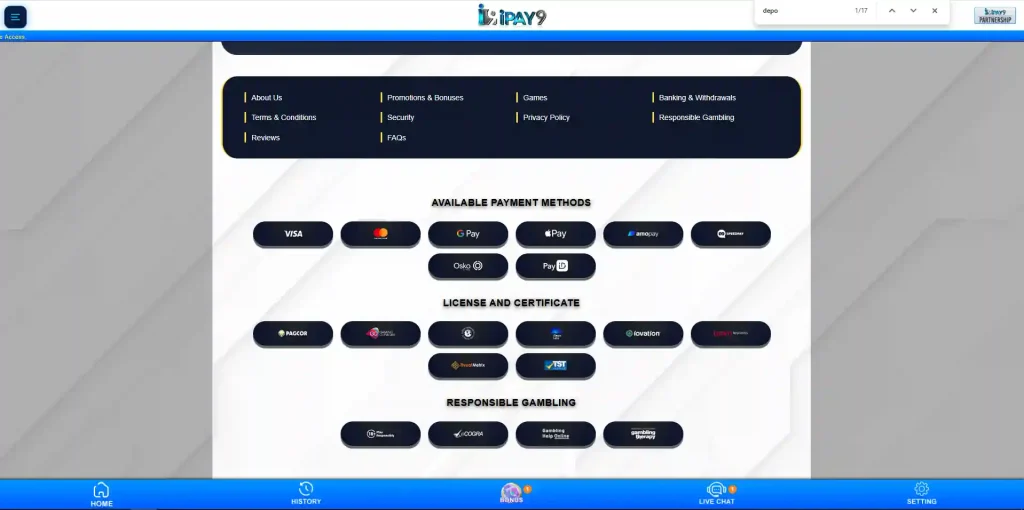
iPAY9’s current Australia-facing site confirms bank transfer and crypto as supported payment categories. Before depositing, open the live cashier and verify the method offered to your account, the displayed currency, any minimum or maximum, fees, recipient or wallet details, and any instructions attached to that transaction. Do not rely on an old review for those live values.
That distinction matters for Australian users. A platform can support bank transfer or crypto generally while the exact route, account details and limits shown in the cashier change. Australian consumers are also highly accustomed to online and mobile payments, so a familiar-looking transfer flow can feel routine. Treat familiarity as a usability signal, not as proof that a particular method or term is currently available at iPAY9.
Table of Contents
- Which deposit methods are verified?
- A practical deposit sequence
- Why the live cashier matters more than a method list
- Bank transfer deposits for Australian users
- Crypto deposits need a different checklist
- What if a bank transfer is pending or unmatched?
- Check the withdrawal side before the first deposit
- Deposit decision checklist
- Choose the deposit route by reversibility and clarity
- Bottom line
- iPAY9 Payments in Australia: Deposits, PayID and Withdrawals
Which deposit methods are verified?
The verified starting point is simple: iPAY9 supports bank transfer and crypto. The brand’s AU-facing page describes deposits as a selection-and-confirmation process. It does not, on the public page used for this review, establish a universal minimum deposit, zero-fee policy or instant-credit guarantee. Those values should therefore come from the live cashier rather than from a static article.
| Deposit route | What is verified | What you still need to check |
|---|---|---|
| Bank transfer | Supported as a payment category | Live recipient details, reference, account-name requirements, displayed limits, fees and timing |
| Crypto | Supported as a funding category | Accepted asset, network, wallet address, displayed limits, confirmations and any conversion treatment |
| PayID | Relevant to Australian account-to-account payments | Whether it actually appears as an iPAY9 cashier option for your account |
If you need the broader context first, the payment overview separates verified iPAY9 methods from payment methods that are simply common in Australia.
A practical deposit sequence
- Sign in through the current iPAY9 site and open the deposit or cashier area.
- Check which methods are displayed for your account rather than assuming every supported category is available in the same form to every user.
- Confirm the currency shown for the transaction. If the cashier shows AUD, use the displayed AUD figure rather than converting a value quoted elsewhere.
- Read any minimum, maximum or fee shown before confirmation. This guide does not substitute an old static number for a live cashier value.
- For bank transfer, copy the current recipient and reference details exactly. If an account-name instruction is displayed, follow it.
- For crypto, verify both the asset and network before sending. A correct address format does not make the wrong network safe.
- Keep the transaction confirmation until the balance is credited or the issue is resolved.
The goal is not to add extra ceremony to a simple deposit. It is to make sure the transaction you authorise matches the instructions that are current for your account.
Why the live cashier matters more than a method list
Payment reviews often collapse two different facts into one. The first is that a platform supports a broad category such as bank transfer. The second is that a specific route, provider, minimum, fee and processing expectation is available to a specific user today. Only the first is established by the current public iPAY9 AU page.
The live cashier is where transaction-level conditions should be checked. This is especially important if you have previously used the platform, because saved instructions, archived images or third-party articles can outlive the details they describe. If the current cashier differs from an old guide, use the cashier.
Bank transfer deposits for Australian users
Bank transfer is a familiar account-to-account concept, but the operational details still matter. Use only the bank details supplied by the current iPAY9 cashier for the transaction. Check the recipient name, account information and any required payment reference before authorising the transfer. A missing or incorrect reference can make a valid payment harder to match to the correct casino account.
Australian payment behaviour makes mobile and online account payments common, but that does not justify assuming a specific local rail. In particular, PayID should not be treated as an iPAY9 deposit option merely because it is widely used in Australia. If PayID is the method you want, use the dedicated PayID and verify that the option is actually shown in your live cashier.
Do not send money to bank details copied from a forum, review or old saved image. The useful evidence is the payee information displayed for the current transaction.
Crypto deposits need a different checklist
Crypto removes some bank-transfer fields but introduces its own failure points. Start by checking which asset the cashier accepts and which network the deposit address belongs to. Then compare the address carefully before sending. If the cashier displays a memo, tag or similar identifier, treat it as part of the destination information rather than optional text.
This page does not publish a fixed crypto coin list because the verified fact is the broader availability of crypto funding, not a permanent list of supported assets. It also does not claim that crypto deposits are automatically faster or cheaper than bank transfers. Speed and cost depend on the current cashier terms, the selected network and external transaction conditions.
If you do not already understand wallet addresses and networks, a conventional bank transfer can be easier to audit because the payee and transfer fields are more familiar. Convenience is a better selection criterion than assuming one route is universally superior.
What if a bank transfer is pending or unmatched?
A delayed balance update does not prove that the transfer failed. First confirm that your banking app shows the payment as sent or completed. Then compare the amount, recipient details and any reference with the instruction shown for the transaction. Keep the receipt or transaction identifier so support can locate the payment if needed.
If the details match but the balance has not updated, use the platform’s support channel and provide the non-sensitive transaction information it requests. Do not create repeated duplicate deposits just to test whether the cashier is working, and do not resend funds to alternative details supplied by an unrelated third party.
What information is useful when asking support about a deposit?
The transaction date, amount, method and bank or blockchain transaction reference are usually more useful than a general statement that the balance is missing. Share information only through the official support flow, and do not publish account credentials or private wallet keys.
Check the withdrawal side before the first deposit
A deposit decision is incomplete if you have not looked at cashout. iPAY9’s AU-facing site confirms linked bank accounts for withdrawal requests, while this guide does not assign an exact payout time, fee or limit. Before funding, inspect the withdrawal area if available and note what destination and verification status it expects.
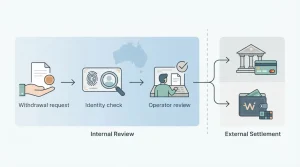
This can reveal an avoidable mismatch early. For example, a user can be comfortable depositing with one route but later discover that withdrawal requires a different destination or an identity check. The withdrawal guide explains that process as separate stages rather than promising a fixed speed.
Deposit decision checklist
- Use a deposit method that appears in your current cashier.
- Verify the displayed currency and amount before authorising payment.
- Read live limits and fees rather than relying on a static review.
- For bank transfer, copy current recipient and reference details exactly.
- For crypto, verify asset, network and address.
- Confirm any promotion rules separately before assuming a deposit qualifies.
- Keep proof of payment until the casino balance is updated.
- Review withdrawal and verification requirements before committing more than you are comfortable having temporarily tied up in the account.
Choose the deposit route by reversibility and clarity
When more than one funding route is visible, compare them on practical control rather than speed claims. A useful deposit method is one where you can identify the recipient, understand the currency being sent, recognise any charge before approval and keep a clear transaction record. Those checks matter whether the route is a bank transfer or crypto.
For bank transfer, verify the recipient information and any payment reference every time you start a new transaction. For crypto, verify the asset and destination details shown for that transaction before sending. Do not reuse old instructions merely because a previous deposit succeeded. The live cashier should be treated as the transaction record you are acting on.
If a deposit does not appear as expected, avoid immediately sending a second payment. First compare the transaction confirmation with the cashier instruction and then contact support with the non-sensitive reference details available to you. That reduces the chance of turning one unresolved deposit into two separate transactions that have to be traced.
Bottom line
Bank transfer and crypto are verified deposit categories at iPAY9 for the Australia-facing service. The useful next step is to verify the live cashier, currency, recipient details and method-specific conditions immediately before payment.
For broader context, return to the main review. For payment-specific decisions, use the payment overview, PayID page and withdrawal guide rather than treating all funding and cashout questions as one process.
iPAY9 Payments in Australia: Deposits, PayID and Withdrawals

iPAY9 PayID in Australia: What to Verify Before Paying
PayID is a mainstream Australian account-to-account payment method, and an AU-focused independent review reports PayID-style...
iPAY9 Withdrawals in Australia: Methods, KYC and Checks
iPAY9's current Australia-facing site states that withdrawals can be requested through linked bank accounts and...